

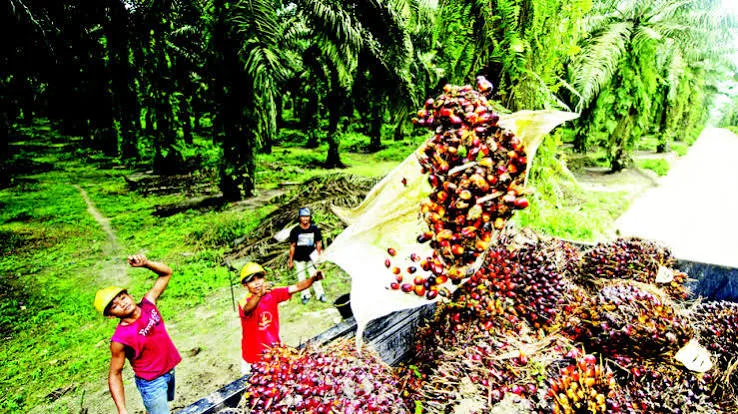
Okomu Oil Palm Company Plc and the Foundation for Partnership Initiatives in the Niger Delta (PIND) have supported 500 farmers from 17 communities in Edo State with practical knowledge and resources aimed at improving agricultural productivity and strengthening rural livelihoods.
The initiative was delivered through two Green Field Days held on September 28 and 29, 2026, in Udo, Ovia South-West Local Government Area, and Odighi, Ovia North-East Local Government Area.
Held under the theme, “From Training to Adoption: Promoting Improved and Climate-Smart Agricultural Practices,” the programme is part of the PIND/Okomu Corporate Social Responsibility Livelihood Project.
The field days were designed to take farmers beyond classroom-based training by allowing them to see and practise improved farming methods on demonstration plots.
During the sessions, technical service providers engaged the farmers on improved cassava production, including the use of improved cassava stems, appropriate planting methods, spacing and farm-establishment techniques.
Farmers also received practical demonstrations on production methods for oil palm, cocoa and rubber. Selected participants were provided with adoption-support inputs, including cassava stems, fertilisers and herbicides, to help them begin applying the practices demonstrated during the programme.
Beyond the farm demonstrations, the initiative connected participants with local technical service providers who can provide continued advisory and mentorship support.
Farmers were also brought together with accredited input dealers, large-scale buyers, financial institutions and other market players to improve their access to agricultural inputs, financing and markets.
PIND said the approach was designed to help farmers continue accessing essential services through existing commercial channels rather than remain dependent on project support.
The programme also included an access-to-finance component. According to PIND, Sombrierio Kapital, its special-purpose vehicle, facilitated an engagement around financing opportunities, including an input-financing facility approved by Sterling Bank Plc for 500 profiled smallholder farmers through an aggregation model.
Speaking on behalf of Okomu Oil Palm Company Managing Director, Dr Graham Hefer, the company's Smallholder Scheme Manager, Sam Aisien, said the objective was to ensure that investments in neighbouring communities produced practical and lasting improvements in people's livelihoods.
He said giving farmers access to effective farming methods, appropriate inputs and continued technical and market support would put them in a stronger position to improve productivity, develop more resilient farm businesses and improve their living conditions.
PIND's Economic Development Manager, Misan Edema-Sillo, who represented the foundation's Executive Director, Sam Ogbemi Daibo, said the programme was focused on closing the gap between agricultural training and actual adoption.
According to him, farmers derive greater value from training when they have the opportunity to apply what they have learnt while receiving access to the inputs, advisory services and market connections required to sustain those practices.
The participating farmers also committed to replicating the demonstrated practices on their farms, while technical service providers outlined plans for follow-up and monitoring of adoption.
The Green Field Days are part of a wider ₦1.2 billion, three-year partnership between Okomu Oil Palm Company and PIND aimed at promoting sustainable development in communities around the company's operations in Edo State.
The partnership extends beyond agriculture. In August 2026, Okomu Oil, PIND, ETIN Power Limited and the Gbelebu community commissioned a 61-kWp solar hybrid mini-grid in Gbelebu, Ovia South-West LGA.
The facility, which has a 50-kW inverter and 154-kWh battery storage capacity, was designed to initially provide electricity to 100 households and businesses in the community.
Through the livelihood programme, Okomu Oil and PIND said they are working to strengthen the agricultural market system around the company's neighbouring communities by connecting practical farming knowledge with technical assistance, quality inputs, finance and commercial opportunities.
The organisations said the broader objective is to help farmers improve productivity, manage climate and production risks and build more sustainable and profitable agricultural businesses.
The latest intervention adds agriculture to a wider community-development programme that includes access to finance, renewable energy, employment and other initiatives intended to support economic opportunities in Okomu's neighbouring communities.



Reader Comments (0)
No comments yet. Be the first to share your perspective on this report.