

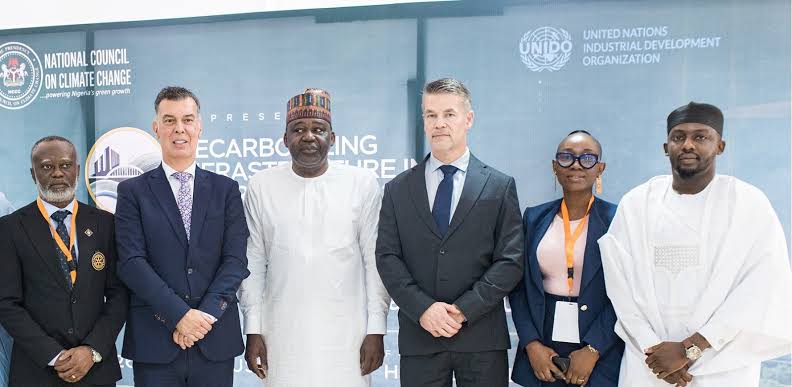
APM Terminals Nigeria has called for stronger cooperation among government, private-sector operators, investors and development partners to accelerate the development of green maritime infrastructure and support Nigeria’s transition to lower-carbon logistics.
The call was made by the company’s chairman, Frederik Klinke, at the second Decarbonising Infrastructure in Nigeria (DIN) Summit, held at the United Nations House in Abuja on September 29, 2026.
The summit focused on ways of making green infrastructure projects more attractive to investors. Current summit materials describe the theme as “De-risking Green Infrastructure Investment in Nigeria: Enabling Policy, Project Readiness and Risk-Sharing Solutions.”
Klinke said Nigeria had made progress in climate action and maritime reforms but argued that the next phase should concentrate on moving from policy commitments to projects that can be financed and implemented.
He said the country needed to develop practical, investment-ready projects capable of delivering both environmental and economic benefits rather than allowing climate strategies to remain largely at the policy level.
For the maritime industry, Klinke said the transition was particularly important because shipping and port operations are central to international trade. He argued that cleaner and more efficient maritime infrastructure could help Nigeria reduce emissions while improving the performance of its logistics system.
He identified several areas that require attention, including regulatory certainty, stronger project preparation, reliable emissions data and better connections between ports and road, rail and inland logistics networks.
According to Klinke, these factors would help create greater confidence for investors considering long-term green infrastructure projects.
The company’s chief executive officer in Nigeria, Koen De Backker, also stressed that decarbonisation should not be viewed solely as a question of replacing conventional fuels.
He said improving the efficiency of port and logistics operations could itself contribute to lower emissions by reducing unnecessary equipment use and fuel consumption, shortening truck waiting times, reducing congestion and improving the movement of cargo.
Cleaner energy systems and lower-emission technologies, he added, could then complement those operational improvements.
The emphasis on efficiency forms part of APM Terminals’ wider electrification strategy for Nigeria. In July 2025, the company and consultancy Systemiq published a study outlining a potential pathway for electrifying container transport in the country.
The study estimated that electrification could mobilise up to $830 million in investment by 2030, while potentially creating skilled jobs, improving energy reliability and reducing greenhouse-gas emissions and air pollution.
Representing Vice President Kashim Shettima at the summit, Deputy Chief of Staff Senator Ibrahim Hadejia called for policy reforms, stronger public-private partnerships and mechanisms that can reduce or share investment risks.
He said private investors, development finance institutions and institutional investors would have important roles to play in mobilising the long-term funding needed for green infrastructure.
Musaddiq Adamu, the Personal Assistant to the President on Subnational Infrastructure and a representative of the DIN Summit Steering Committee, said the summit was intended to help close the gap between green infrastructure ideas and projects that are ready to attract investment.
He also pointed to progress on port electrification following discussions from the earlier DIN Summit.
One of the most significant developments has been the partnership between APM Terminals’ West Africa Container Terminal (WACT) in Onne and the Nigerian Ports Authority.
In September 2025, APM Terminals and the NPA signed a memorandum of understanding to develop a roadmap for electrifying containerised freight and advancing decarbonisation across Nigeria’s port and transport ecosystem. The company said the initiative would be fully funded by APM Terminals at a cost of $60 million.
The NPA said the project could position Onne as Nigeria’s first green port and serve as a model for more sustainable port operations.
APM Terminals currently operates container terminals at Apapa in Lagos and WACT in Onne, Rivers State, as well as a container depot in Kano.
The company has also identified electricity supply and equipment electrification as two important areas for Nigeria's transition to cleaner container logistics.
Its 2025 white paper argued that electrification could extend beyond port machinery to include cleaner power infrastructure and electric trucking corridors, creating a broader low-emission freight network.
APM Terminals said the transition could also generate wider economic benefits, including new skilled employment opportunities and improved public-health outcomes through reductions in air pollution.
The company’s partnership with the NPA therefore represents an existing project within Nigeria’s broader effort to develop greener maritime infrastructure, rather than simply a future proposal.
At the Abuja summit, Klinke urged stakeholders to focus on implementation and create the financing, regulatory and partnership structures required to move green infrastructure projects from planning to execution.
For Nigeria, the issue extends beyond environmental targets. More efficient ports, reliable energy systems and better-connected freight networks could also affect the cost and speed of moving goods through the country.
As investment interest in cleaner infrastructure grows, the challenge will be turning policy commitments and pilot projects into scalable developments capable of delivering measurable environmental, operational and economic benefits.
Reporting by TalkNaijaMedia



Reader Comments (0)
No comments yet. Be the first to share your perspective on this report.