

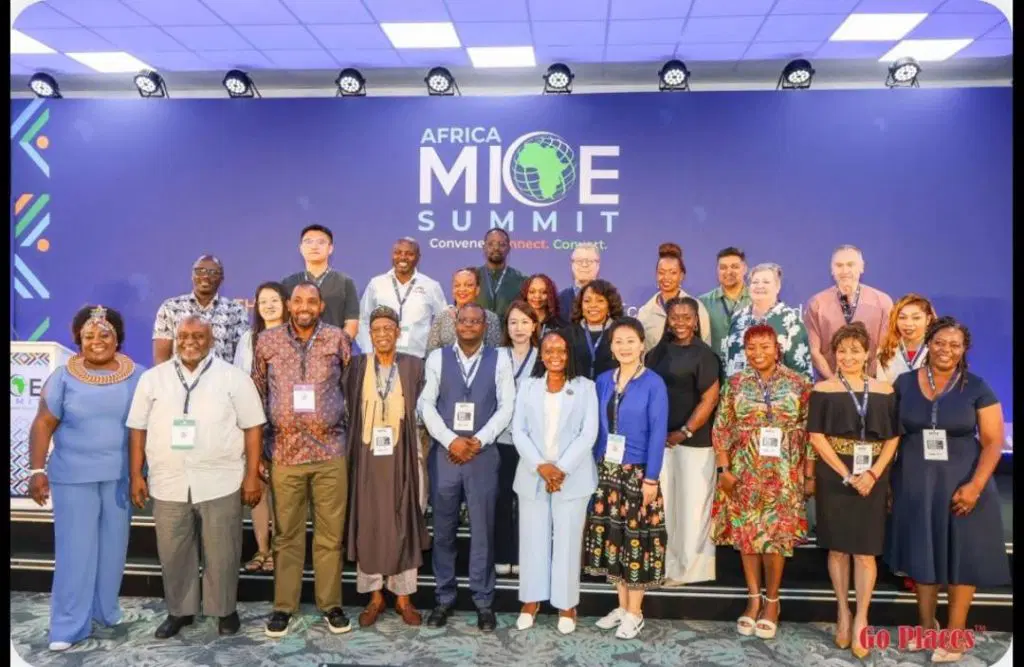
Former Nigerian Minister of Information and Culture, Lai Mohammed, has called on African governments to give greater economic attention to the Meetings, Incentives, Conferences and Exhibitions (MICE) industry, saying business events can play a larger role in attracting investment, expanding trade and creating employment across the continent.
Mohammed made the call while speaking at the ninth Africa MICE Summit in Mombasa, Kenya, held under the theme, “Building Africa’s MICE Ecosystem for Trade, Investment and Innovation.” The summit took place from October 1 to 2, 2026.
According to Mohammed, the global MICE market is estimated at about $1.3 trillion, while Africa accounts for roughly four per cent. Kenya News Agency, citing International Congress and Convention Association data, similarly reported that Africa represented about four per cent of the global MICE market in 2025.
The former minister argued that African countries should look beyond the immediate tourism benefits of hosting conferences and exhibitions. In his view, major business events can bring investors, buyers, policymakers, experts and companies directly into African markets, creating opportunities for commercial partnerships and new investments.
He said the continent should therefore begin measuring the success of MICE activities not only by the number of delegates who attend or hotel rooms occupied, but also by the investments, trade relationships, partnerships and jobs generated after the events.
Mohammed also urged individual countries to build MICE strategies around their existing economic and cultural strengths instead of attempting to compete for exactly the same events.
He pointed to Nigeria’s entertainment industry, Kenya’s athletics and tourism sectors, South Africa’s established conference market and Rwanda’s growing reputation as a regional business destination as examples of areas that could support stronger MICE strategies.
The former minister also proposed greater cooperation among African countries in bidding for major international events. He argued that countries could share hosting responsibilities where the scale of an event makes a single-country bid difficult.
He cited the joint hosting model used for the 2026 FIFA World Cup by Canada, Mexico and the United States as an example of how countries can work together to stage major international events.
Mohammed further identified Lagos as a city with considerable potential for developing its business-events economy. He referred to research commissioned during his time as minister that, according to his account, indicated that about 20,000 events were taking place in the city each month.
He also pointed to the growth of Nigeria’s “Detty December” period as an example of how major events can create economic activity across several industries, including aviation, hospitality, transportation, entertainment, fashion, media, technology and retail.
Beyond attracting events, however, Mohammed said African destinations need the infrastructure required to host them successfully.
He identified convention centres, hotels, airports, transportation systems, digital infrastructure and reliable utilities as important requirements for attracting major international conferences and exhibitions.
Improving movement between African countries was another issue highlighted at the summit. Industry stakeholders have called for better air connectivity, lower travel costs and easier visa arrangements to make it more convenient for business travellers to move around the continent. Kenya News Agency reported that these issues were among the major concerns raised by MICE stakeholders during the Mombasa summit.
Mohammed also argued that infrastructure alone would not be enough. He said African countries need stronger investment environments, predictable policies, effective institutions and greater confidence among investors.
He further advocated the establishment or strengthening of National Convention Bureaux that could coordinate government and private-sector efforts, bid for international events, support visiting businesses and collect data on the economic impact of the MICE industry.
The idea is to make business events part of a broader economic strategy rather than treating each conference or exhibition as an isolated occasion.
For smaller African countries, Mohammed said there is also an opportunity to position themselves as gateways connecting businesses and markets across the continent.
Rwanda, which has developed a growing profile as a regional business-events destination, was cited as an example of how strategic positioning can help a smaller market attract international conferences and investment-related gatherings.
The Africa MICE Summit itself was designed around similar objectives, with its 2026 programme featuring networking, business matchmaking, investment discussions and policy dialogue. The organisers said the event brought together industry professionals, policymakers and other stakeholders interested in expanding Africa’s business-events ecosystem.
The summit attracted participants from multiple African countries, with reports putting the number of represented countries at 19.
For Mohammed, the larger opportunity lies in connecting events to measurable economic outcomes.
Under that approach, the value of a conference would be assessed by what happens after participants leave — whether new investment is secured, trade relationships are established, businesses form partnerships and employment opportunities emerge.
The call comes as African MICE stakeholders continue to push for improved connectivity, infrastructure and investment in the sector. With Africa currently accounting for a relatively small share of the global market, industry participants see room for expansion if countries can address the practical challenges that make business travel and event hosting more difficult.
Reporting by TalkNaijaMedia



Reader Comments (0)
No comments yet. Be the first to share your perspective on this report.