

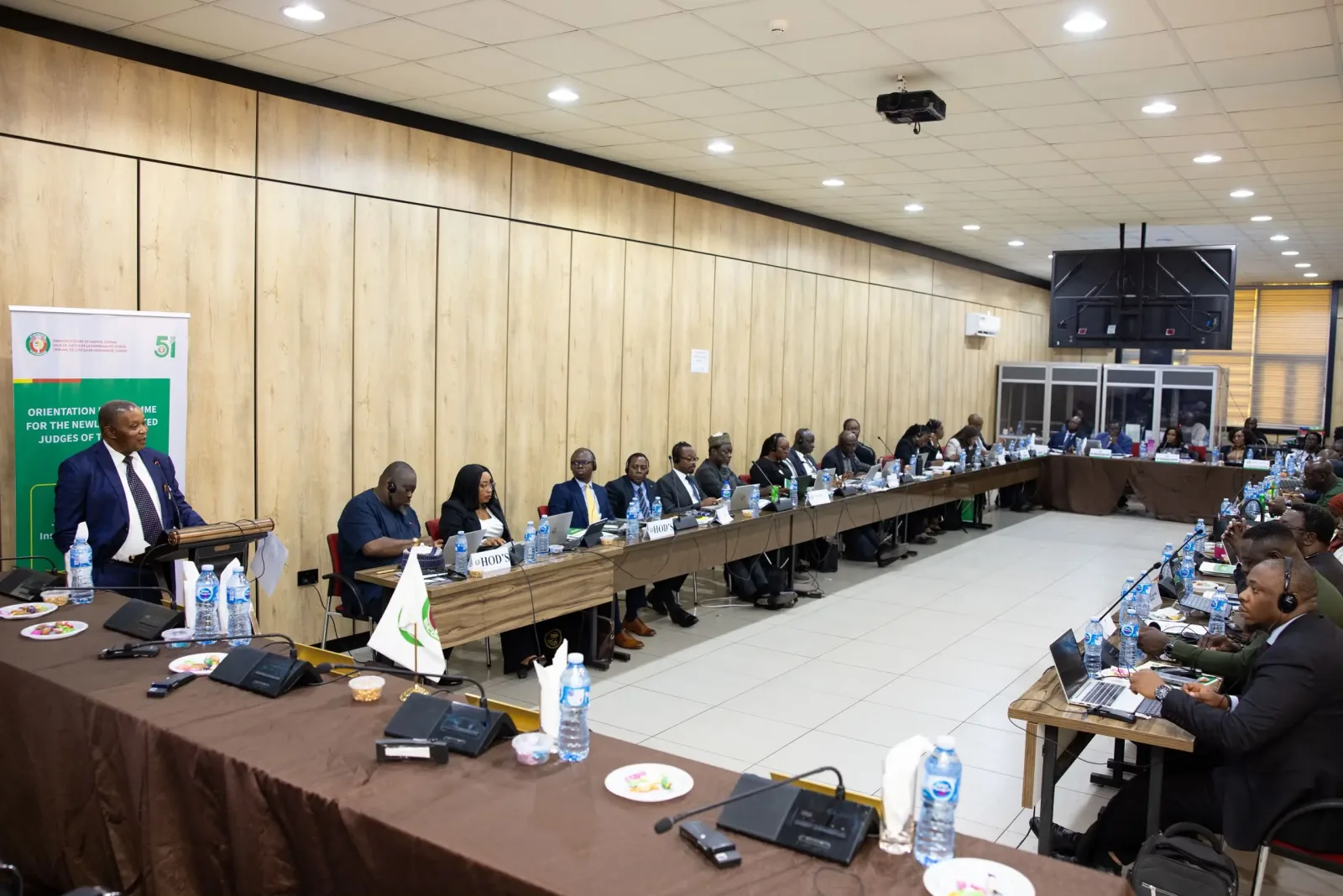
The programme, held under the theme “Becoming an ECOWAS Judge: Judicial Excellence, Institutional Integration and Effective Adjudication,” is designed to prepare the judges for their responsibilities and familiarise them with the Court’s legal framework, procedures and institutional operations.
Brumskine identified three priorities for the new judicial team: independence and integrity, collegiality, and effectiveness. She stressed that public confidence in the regional court depends on the fairness and impartiality of its decisions, alongside the integrity of the judges delivering them.
She urged the judges to promote rigorous deliberations, mutual respect and consistency in their rulings, while taking practical steps to improve the speed of adjudication. Their work, she said, should align with the Court’s Strategic Plan for 2026–2030, known as Justice 2030.
The Court president also emphasised the need to improve compliance with judgments by maintaining engagement with ECOWAS member states. The issue remains important to regional justice because the impact of judicial decisions depends not only on their delivery but also on whether they are implemented.
Congratulating her colleagues on assuming office on October 13, Brumskine said the role required a strong understanding of the ECOWAS legal order, the Court’s jurisdiction and procedures, and the body of regional jurisprudence developed over more than two decades.
The orientation programme also covers judicial ethics, interpretation of legal provisions, access to the Court, admissibility of cases, remedies and reparations. Participants are expected to receive practical exposure to the Court’s Electronic Case Management System, which is intended to support more efficient case handling and improve access to justice.
Acting Chief Registrar Dr Ousmane Diallo said the programme would help integrate the judges and their executive assistants into the Court’s administrative and operational systems. Sessions are designed to familiarise participants with departmental responsibilities, registry operations, case management and the roles of legal, administrative and other support teams.
Diallo said improved communication and cooperation between judges, executive assistants, department heads and staff would help strengthen institutional continuity and operational efficiency.
The five-member judicial college comprises Justice Brumskine of Liberia as president; Justice Désiré Henri Aihou of Benin as vice-president; and Justices Henrietta Uzoamaka Didigu of Nigeria, Yaouza Ouro-Sama of Togo and Awa Bah of The Gambia.
The judges were sworn into office on October 6, 2026, for a four-year, non-renewable term. The new leadership was subsequently elected on October 13.
The orientation programme marks an early step in the new college’s work as the Court pursues its 2026–2030 strategic priorities. Its stated focus on judicial independence, timely adjudication and stronger compliance is aimed at supporting a more effective regional justice system and maintaining public confidence in the ECOWAS Court.
Reporting by TalkNaija Media





Reader Comments (0)
No comments yet. Be the first to share your perspective on this report.