

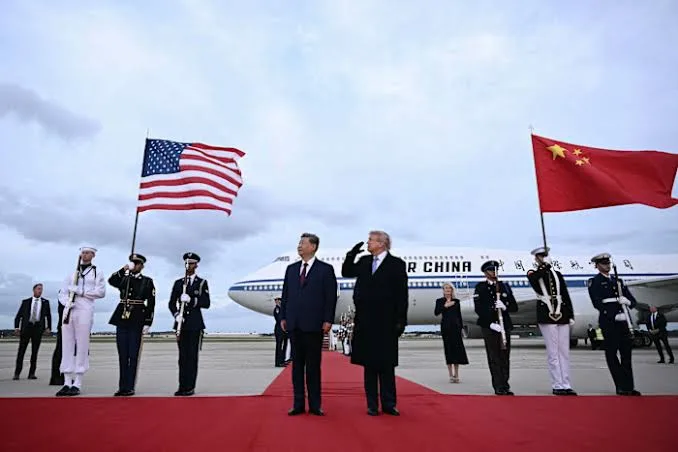
The strategic rivalry between the United States and China is entering a broader phase in which economic power, technology, infrastructure and control of critical networks are becoming increasingly important alongside traditional military and diplomatic influence.
Financial Times columnist Rana Foroohar has described the evolving competition as a modern version of the 19th-century “Great Game”, the term historically associated with the rivalry between Britain and Russia for influence in Central Asia.
In a recent Financial Times analysis, Foroohar argued that the current US-China competition stretches across economic, political, geographic and virtual domains. Rather than being limited to tariffs, manufacturing or military strength, she sees the contest as a struggle over the systems and networks that support global commerce.
The analysis places particular emphasis on what can broadly be described as systems dominance — the ability of a country to influence the infrastructure, rules, technologies and networks on which other economies depend.
China has increasingly sought to expand its influence through investments and commercial relationships involving ports, shipping, supply chains, energy resources, digital infrastructure and emerging technologies. Its Belt and Road Initiative has also provided a platform for infrastructure and trade projects across multiple regions.
The US, meanwhile, retains significant advantages in areas including the global role of the dollar, major technology companies and maritime security. Foroohar's analysis suggests that neither side has complete dominance across all of the systems that underpin the global economy, making the competition more complex than a straightforward contest between two powers.
Ports and maritime trade have become an important part of this competition. Control or influence over strategic ports and shipping networks can affect the movement of goods and resources while giving countries greater economic and geopolitical leverage.
The rivalry also extends into technology and technical standards. As countries compete in areas such as artificial intelligence, digital infrastructure and advanced manufacturing, the standards adopted internationally can influence which technologies become widely used and which companies gain access to global markets.
Critical resources are another area of competition. Access to minerals and other strategic materials is increasingly important as governments seek to strengthen supply chains for advanced technologies, energy systems and manufacturing.
The Arctic is emerging as another significant arena. Melting sea ice is opening greater interest in northern shipping routes and natural resources, while Russia, China, the United States and other Arctic stakeholders are seeking to protect or expand their respective interests in the region.
China has previously described itself as a “near-Arctic state” and outlined its concept of a Polar Silk Road, linking Arctic development to its wider infrastructure and trade ambitions. The United States has expressed concerns about China's growing activity in the region.
Foroohar's wider work on the Arctic also examines how shipping routes, shipbuilding capacity, underwater communications infrastructure and natural resources could affect economic and strategic power in the coming decades.
The comparison with the historical Great Game, however, should be understood as an analytical metaphor rather than a direct repetition of 19th-century geopolitics. Today's international system includes many influential actors, including India, Japan, European countries and Southeast Asian states, which can pursue their own interests rather than simply align with Washington or Beijing.
That means countries caught between the two major powers may have considerable influence over how the rivalry develops. Foroohar's analysis similarly points to middle powers and other states as important participants in the emerging strategic landscape.
The changing nature of the rivalry means that influence may increasingly depend on who builds and controls the networks through which goods, energy, information, technology and capital move.
For the United States and China, the competition is therefore no longer simply about who produces more goods or possesses greater military strength. It is increasingly about who can shape the infrastructure, standards and strategic networks that define how the global economy operates.
The emerging contest is likely to remain a long-term process involving competition as well as cooperation, with the decisions of other countries helping determine how the global balance of economic and technological influence evolves.
Reporting by TalkNaijaMedia


Reader Comments (0)
No comments yet. Be the first to share your perspective on this report.