
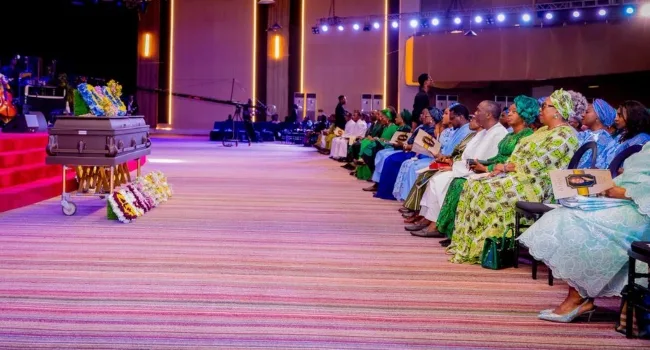
The curtain has come down on the funeral ceremonies for veteran Nigerian actor and film executive Oludotun Baiyewu Jacobs, popularly known as Olu Jacobs, as the entertainment industry gathered in Lagos to honour his life and enduring contribution to theatre, television and film.
The funeral service was held on Friday, October 2, 2026, at This Present House on Freedom Way, Lekki Phase I, Lagos, bringing together members of Jacobs’ family, fellow actors, government officials and other dignitaries. A private burial was scheduled to follow the service.
Among the dignitaries at the ceremony was Lagos State Deputy Governor Obafemi Hamzat, who attended alongside his wife, Oluremi Hamzat. The Lagos State First Lady, Ibijoke Sanwo-Olu, and former Ogun State Governor Ibikunle Amosun were also among those announced as attendees.
Hamzat paid tribute to the late actor, describing him as an icon of Nigeria’s entertainment industry and reflecting on his contribution to the country’s creative sector.
Nollywood was also strongly represented at the service, with several actors and industry figures joining the Jacobs family to bid farewell to one of the most recognisable faces in Nigerian entertainment.
Singer Dare Art Alade performed his song Pray for Me during the service, while actors including Kate Henshaw, Stan Nze and Ernest Obi were among the entertainment personalities present.
The funeral followed a Night of Tributes held on Wednesday, September 30, at Glover Memorial Hall in Lagos Island, where colleagues from different generations gathered to celebrate Jacobs’ career and share memories of his influence on the Nigerian entertainment industry.
Several actors used the tribute events to recount the impact Jacobs had on their careers. Actress Sola Sobowale, for instance, described him as one of the people who trained and guided her in the Nigerian movie industry, recalling his role in shaping her development as an actor.
Jacobs died on September 16, 2026, at the age of 84. His death was announced by his son, Olusoji Jacobs, who shared a statement from the family describing him as “The Lion of Lufodo” and appealing to the public and social media influencers to respect the family’s privacy during the mourning period.
Born on July 11, 1942, Jacobs built a career spanning more than five decades across theatre, television and film. He trained at the Royal Academy of Dramatic Art in London and worked in British theatre and television before returning to Nigeria, where he became one of the defining figures of the country’s film industry.
His British screen credits included appearances in productions such as The Goodies and The Professionals, while his international film work further established his reputation before his emergence as one of Nollywood’s most respected performers.
Back in Nigeria, Jacobs became particularly known for commanding performances as traditional rulers, chiefs, fathers and other authoritative characters. His distinctive voice and stage presence made him a recognisable figure to generations of Nigerian television and film audiences.
Beyond acting, Jacobs and his wife, veteran actress Joke Silva, co-founded the Lufodo Group and the Lufodo Academy of Performing Arts, extending their contribution to Nigeria’s creative sector beyond performance. The couple married in 1989 and had children together.
Jacobs received several honours during his career, including the Africa Movie Academy Award for Best Actor in a Leading Role in 2007 and Nigeria’s national honour of Member of the Order of the Federal Republic, MFR, in 2011. He also received the Industry Merit Award at the Africa Magic Viewers’ Choice Awards and a lifetime achievement award.
His death prompted tributes from government officials, actors, filmmakers and fans across Nigeria, many of whom highlighted his influence on the professional development of the country’s entertainment industry.
As family and colleagues said their final goodbye in Lagos, the funeral marked the closing chapter of the public farewell to a performer whose career crossed British theatre, international productions and the growth of modern Nollywood.


Reader Comments (0)
No comments yet. Be the first to share your perspective on this report.