

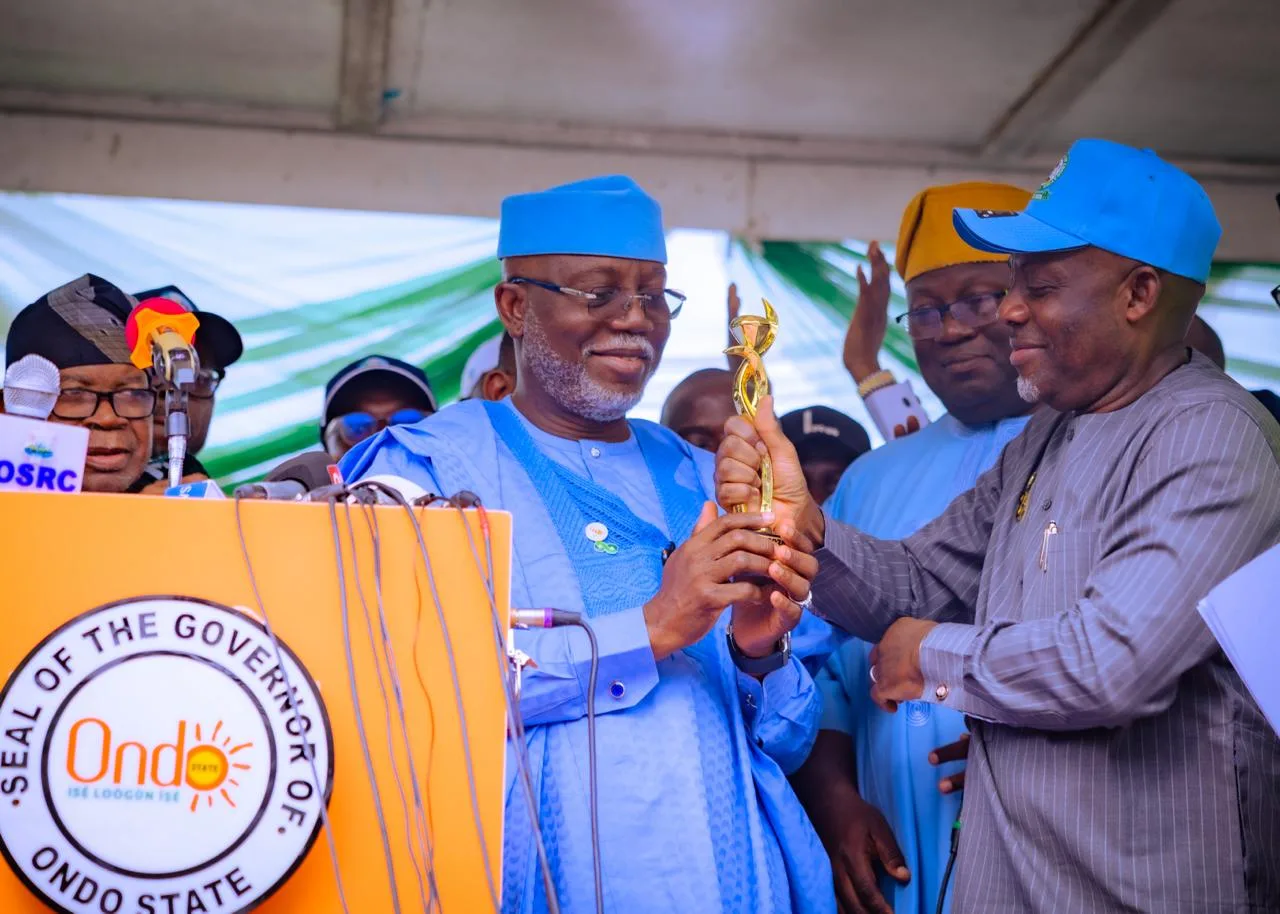
Ondo State Governor Lucky Orimisan Aiyedatiwa’s recognition by the Federal Government for his administration’s contributions to education has renewed attention on his personal journey from the classroom to the state’s highest elected office.
The governor received a Special Recognition Award at the 2026 World Teachers’ Day Commemoration and President’s Teachers’ and Schools’ Excellence Awards in Abuja on October 5. The Minister of Education, Dr Tunji Alausa, presented the award, which Aiyedatiwa dedicated to teachers across Ondo State.
For Ondo State Attorney-General and Commissioner for Justice, Dr Olukayode Ajulo, SAN, the recognition carries a personal significance. In a reflection published by THISDAY, Ajulo recalled conversations with the governor about his early life, education and experience as a teacher, describing the award as a moment that brought different stages of Aiyedatiwa’s life together.
According to Ajulo, Aiyedatiwa grew up in the riverine community of Obe-Nla before travelling to Lagos, where he continued his education. His educational journey, as recounted by the Attorney-General, included attendance at a Jakande school and studies at the College of Education, Ijanikin, before he entered the teaching profession.
Ajulo also recalled a period when questions were raised about the governor’s academic qualifications. He said the controversy was addressed through the use of a WAEC verification platform and that former classmates and students subsequently came forward to speak about their experiences with Aiyedatiwa as a teacher.
The Attorney-General said the accounts shared by former students left an impression on him, particularly their recollections of the governor’s character and influence in the classroom. He explained that these encounters contributed to his personal nickname for the governor, “Bro Lucky.”
The account of the credential controversy and the former students’ testimonies comes from Ajulo’s personal recollection. The award itself, however, has been independently reported by several news organisations, including The Guardian and the News Agency of Nigeria.
Aiyedatiwa’s background as a teacher was also highlighted during his acceptance of the award. According to reports from the event, he said his classroom experience continued to shape his understanding of governance and the responsibilities associated with educating young people. He dedicated the recognition to teachers whose work, he said, remained essential to the state’s development.
Ajulo’s reflection also pointed to the governor’s choice of Professor Igbekele Ajibefun, a former rector and vice-chancellor, as Commissioner for Education. He presented the appointment as an indication that professional experience was an important consideration in the administration’s approach to the education portfolio.
The governor’s administration has reported a number of interventions in the sector. Figures presented by Aiyedatiwa at the national event included the recruitment of more than 2,100 teachers in 2025, the construction of 43 classroom blocks and the renovation of 75 schools.
He also said the state spent ₦633.9 million to cover 2026 WAEC registration fees for 23,048 public-school students and sponsored National Business and Technical Examinations Board examinations. Other reported interventions included the provision of learning materials and school furniture, teacher development programmes, and bursary and scholarship support.
These figures reflect claims made by the state government and reported by news organisations. Their long-term impact will depend on factors such as the quality of teaching, the condition of school facilities, students’ access to learning resources and measurable improvements in educational outcomes.
Access to school has also featured in the administration’s reported initiatives. At the World Teachers’ Day event, Aiyedatiwa said the government had deployed shuttle buses and boats to help pupils, particularly those in riverine communities, overcome transportation difficulties. The state has also announced plans to establish a College of Nursing in Igbokoda and a College of Education in Aboto.
For Ajulo, the significance of the award extends beyond the governor’s personal achievement. His argument is that Aiyedatiwa’s experience as a teacher provides a connection between his own educational journey and the public responsibility he now holds.
The broader challenge for any government, however, is to ensure that education spending and policy commitments translate into better learning conditions and opportunities for students. Recruitment figures, renovated classrooms and examination support are important measures, but their value ultimately depends on the results experienced by pupils, teachers and communities.
Aiyedatiwa’s recognition therefore offers an opportunity to reflect on the role teachers play in shaping individual lives and the importance of sustaining investment in education. It also places attention on the work that remains necessary to ensure that children across Ondo State can access quality schooling, regardless of their background or where they live.
Ajulo concluded his reflection by congratulating the governor and expressing hope that the recognition would encourage further service to children and young people in the state.
For a former classroom teacher now leading Ondo State, the award provides a link between his professional past and his present responsibilities. Whether that legacy endures will ultimately be measured not only by honours received, but by the opportunities and educational outcomes delivered to the next generation.
Reporting by TalkNaijaMedia



Reader Comments (0)
No comments yet. Be the first to share your perspective on this report.