

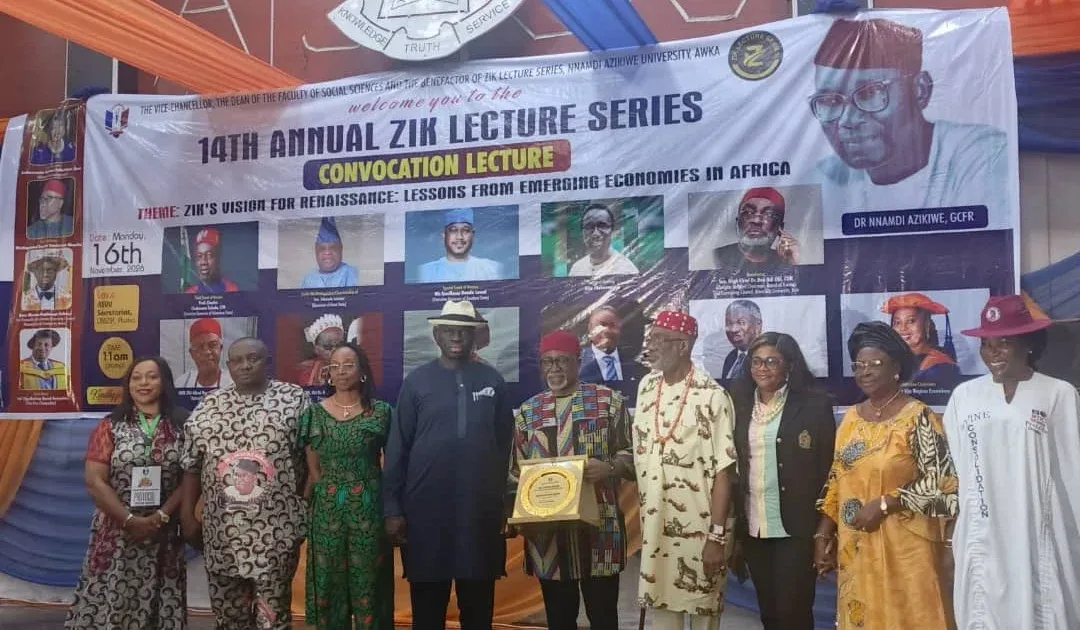
The lecture, themed “Zik’s Vision for Renaissance: Lessons from Emerging Economies in Africa,” examined the leadership philosophy and legacy of Nigeria’s first President, Dr Nnamdi Azikiwe, whose contributions to nationalism, education and African development continue to attract public attention.
Reflecting on Azikiwe’s legacy, Abaribe said Nigeria and several other African countries were still struggling to establish leadership systems built on strong principles, despite the ideals championed by the late nationalist decades ago.
He identified leadership as one of Nigeria’s most pressing challenges, arguing that political authority should be used to improve society through education, national reorientation, infrastructure development and a commitment to the welfare of citizens.
The senator also expressed concern over what he described as declining moral standards in the country. He identified excessive and unchecked exposure to social media, weakening family structures, an overemphasis on academic grades and the celebration of unexplained wealth as factors contributing to the problem.
According to him, a society that celebrates wealth without questioning how it was acquired risks weakening its commitment to integrity and accountability.
Abaribe urged Nigerians to place greater value on honesty and responsible leadership, maintaining that rewarding integrity was necessary to produce leaders who would serve the public interest.
Addressing students at the event, he emphasised that education should go beyond obtaining certificates, stressing that academic qualifications must be accompanied by good character, discipline and a sense of responsibility.
He warned that young people often learn their values from the examples set by those in positions of authority, making it important for political and public office holders to demonstrate the conduct they expect from the younger generation.
The senator also raised concerns about state capture, describing it as a situation in which public institutions and government resources are controlled for the benefit of a few individuals rather than the wider population.
He argued that government policies, justice and public interventions should serve all citizens instead of being designed to favour a limited group.
Abaribe further urged Nigerians to draw lessons from Azikiwe’s commitment to education, national unity and moral values, saying these principles remain relevant to the country's development aspirations.
Also speaking, the benefactor of the Zik Lecture Series, Senator Ben Obi, said the initiative was established to preserve and promote the ideals of Azikiwe.
Obi described the late President as a nationalist who understood the importance of education, independent thinking and civic responsibility in building a strong African society. He also recalled Azikiwe’s efforts towards maintaining Nigeria’s unity.
In his welcome address, the Vice-Chancellor of Nnamdi Azikiwe University, Professor Ugochukwu Bond Anyaehie, described the annual lecture as an important intellectual platform for discussing Nigeria’s political, economic and social development.
Anyaehie said universities should serve not only as institutions for awarding degrees but also as centres for developing ideas capable of addressing society’s challenges.
He noted that Azikiwe’s vision of an African renaissance focused on freeing the continent from political domination, economic dependence and intellectual stagnation.
The vice-chancellor also pointed to the progress recorded by some emerging African economies in areas such as digital innovation, renewable energy, infrastructure development and regional trade, saying their experiences offered useful lessons for the continent.
The annual lecture remains one of the university’s platforms for reflecting on Azikiwe’s contributions and examining how his ideas can inform contemporary leadership and development across Nigeria and Africa.
Reporting by TalkNaijaMedia





Reader Comments (0)
No comments yet. Be the first to share your perspective on this report.