

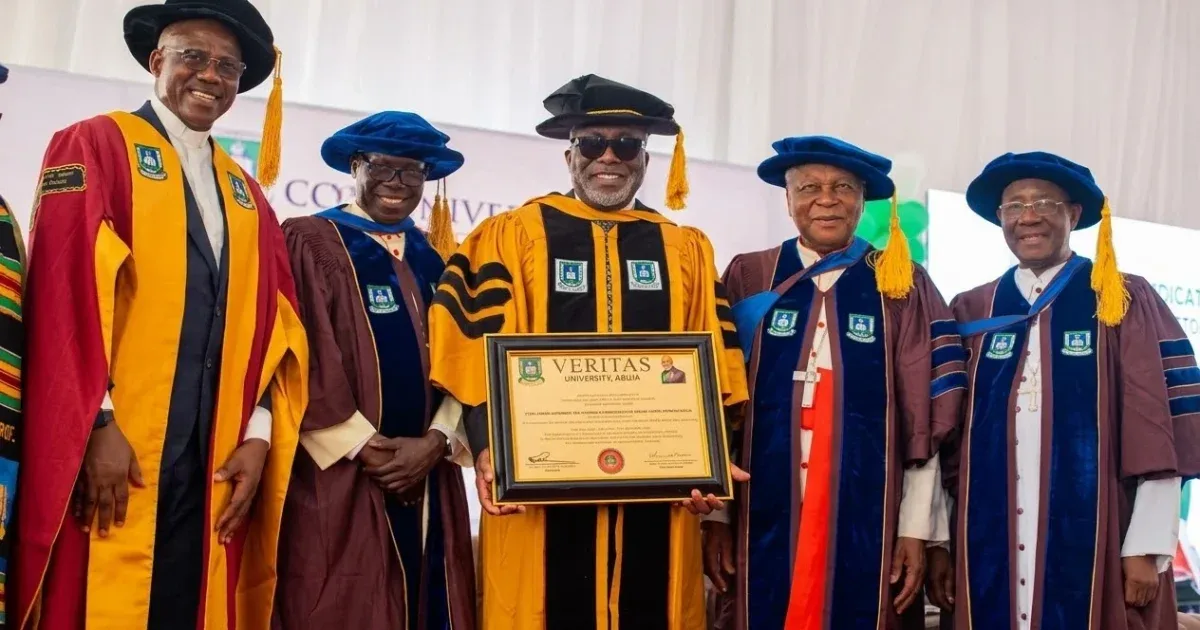
He argued that entrepreneurship should not be restricted to business-related courses but integrated into programmes such as medicine, law, engineering and the sciences.
According to him, students should be encouraged to explore the business opportunities within their respective fields, including turning research findings and professional knowledge into viable enterprises.
The airline chairman maintained that the success of higher education institutions should not be measured simply by the number of graduates produced or certificates awarded, but by the quality of knowledge, practical skills, moral values and sense of responsibility students acquire before leaving school.
Speaking from his experience as an entrepreneur and professor of entrepreneurship, Okonkwo disclosed that he established his business while still a student and had never worked as a salaried employee after graduation.
He explained that early exposure to business opportunities and practical entrepreneurial knowledge played an important role in shaping his career, adding that universities must expose students to the realities of the business world before they complete their studies.
Although he acknowledged that entrepreneurship might not appeal to every graduate, he expressed willingness to mentor and guide students interested in establishing their own businesses.
Beyond entrepreneurship education, Okonkwo called for stronger partnerships between universities and private sector organisations to provide students with practical industry experience through structured internship programmes.
He described industrial training as an important tool for bridging the gap between academic knowledge and workplace requirements.
As an example, he highlighted United Nigeria Airlines' collaboration with Afe Babalola University, Ado-Ekiti, which provides engineering students with opportunities to gain practical experience in aviation maintenance and related technical operations.
The partnership, formalised through a Memorandum of Understanding in February 2026, provides structured industrial training opportunities for eligible engineering students through the Student Industrial Work Experience Scheme (SIWES).
The programme has already received its first batch of students, with 400-level engineering undergraduates commencing a six-month internship in March 2026.
Okonkwo said initiatives of this nature demonstrate how collaboration between universities and industries can improve students' practical knowledge, professional readiness and employment prospects.
He therefore encouraged more private sector organisations to establish similar partnerships with tertiary institutions, noting that practical exposure would help graduates become more competitive in the labour market.
His remarks come amid continuing concerns over graduate unemployment, skills gaps and the ability of Nigeria's formal employment sector to accommodate the growing number of young people entering the workforce.
The call has renewed attention on the need for universities to move beyond conventional classroom teaching by strengthening entrepreneurship education, innovation, technical training and industry-based learning.
Okonkwo's position is that Nigerian universities must produce graduates who can identify opportunities, develop solutions and contribute to economic growth, rather than leave school with academic qualifications alone.
Reporting by TalkNaijaMedia





Reader Comments (0)
No comments yet. Be the first to share your perspective on this report.