

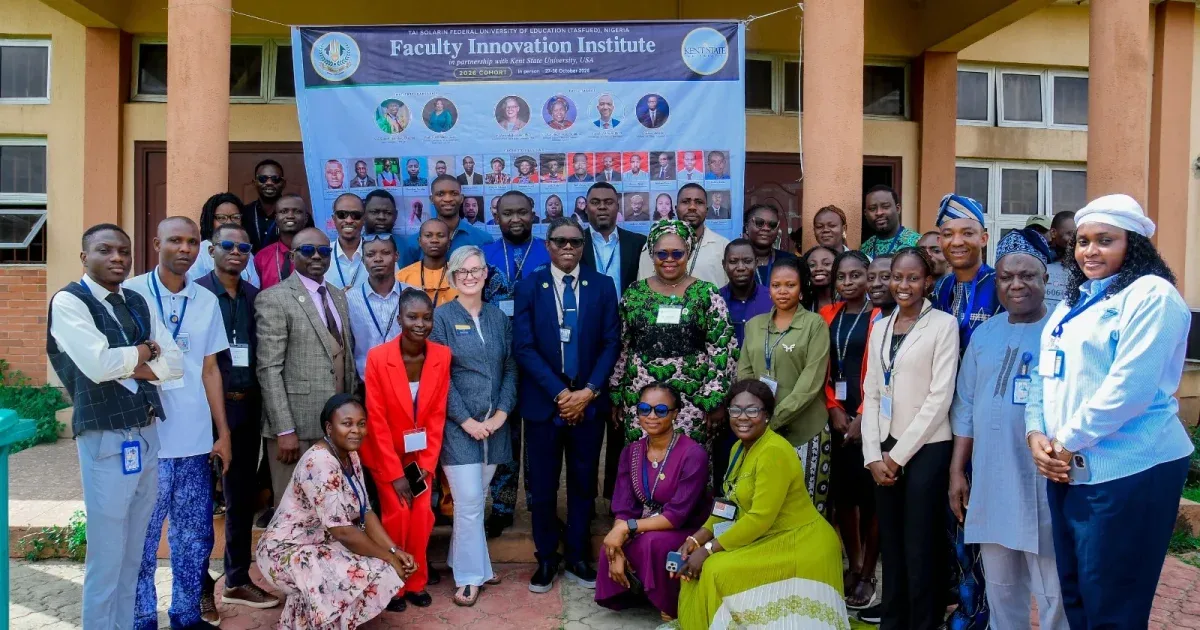
The initiative also adopts a train-the-trainer approach, with participants expected to share the knowledge acquired with colleagues in their respective faculties and departments to encourage wider institutional development.
Speaking during the programme, TASFUED Vice-Chancellor, Professor Samuel Ekundayo Oladipo, described the partnership as an important investment in the university's academic workforce and its commitment to educational innovation.
Oladipo said universities must provide opportunities for young academics to improve their research capabilities, embrace emerging technologies and establish international partnerships that contribute to knowledge development.
He noted that the institution was committed to creating an academic environment where innovation, research excellence and international collaboration could thrive.
The vice-chancellor identified four major areas of focus for the training, including the redesign of teaching and learning, the application of artificial intelligence in education, research and academic publishing, and grant writing.
He explained that these competencies were increasingly important as technological advancements continued to reshape teaching methods and expectations within the global higher education sector.
Oladipo, however, urged participants to focus on applying the knowledge gained rather than treating the programme as an opportunity to obtain certificates.
He challenged the academics to introduce improved teaching approaches, initiate research projects, pursue scholarly publications and support colleagues through mentoring and departmental knowledge-sharing activities.
The vice-chancellor also encouraged responsible use of artificial intelligence in teaching and assessment, stressing the importance of applying technology in ways that improve educational outcomes.
Also speaking, TASFUED Director of Research and External Relations, Professor Adefunke Ekine, said the collaboration was established to promote knowledge exchange between institutions in the Global North and Global South.
Ekine explained that the university recognised the need to provide newly recruited and early-career lecturers with opportunities to develop their teaching, research and academic skills.
She said discussions leading to the partnership began after earlier engagements with Dr Amanda Johnson, who visited the university the previous year.
According to her, the institute would serve as a foundation for further collaboration between both universities, particularly in research development, knowledge creation and academic capacity building.
Ekine also highlighted critical thinking as an important component of the training, noting that it would help lecturers improve classroom participation, encourage creativity and develop students' ability to think independently.
One of the facilitators, Dr Amanda Johnson, Director of the Gerald H. Read Centre for International and Intercultural Education at Kent State University, commended the selected participants for their performance during the programme.
Johnson described the academics as promising and expressed confidence that the training would contribute to lasting improvements in teaching and research activities at TASFUED.
Another facilitator, Dr Kayode Adewale, a Fulbright Teaching Excellence and Achievement Fellow and Microsoft Innovative Educator Fellow, said the programme was designed to strengthen participants' abilities in academic writing, grant applications, artificial intelligence and innovative teaching.
Adewale, who handled the session on redesigning teaching and learning, encouraged lecturers to move beyond conventional lecture-based approaches towards student-centred methods that promote active participation and better learning experiences.
He disclosed that approximately 100 academics initially expressed interest in the programme, but 30 were eventually selected to participate.
He added that the selected lecturers would be expected to transfer the knowledge and skills acquired to other members of their academic communities.
One of the participants, Dr Adebayo Ishola of the Department of Educational Technology, described the institute as beneficial, saying it had exposed participants to fresh approaches to teaching, research and professional development.
Ishola noted that the sessions reinforced the importance of moving away from traditional classroom practices and adopting learning methods that place students at the centre of the educational process.
The partnership reflects ongoing efforts by Nigerian higher institutions to strengthen international academic cooperation, improve research capacity and prepare lecturers for the growing influence of artificial intelligence and other emerging technologies in education.



Reader Comments (0)
No comments yet. Be the first to share your perspective on this report.