

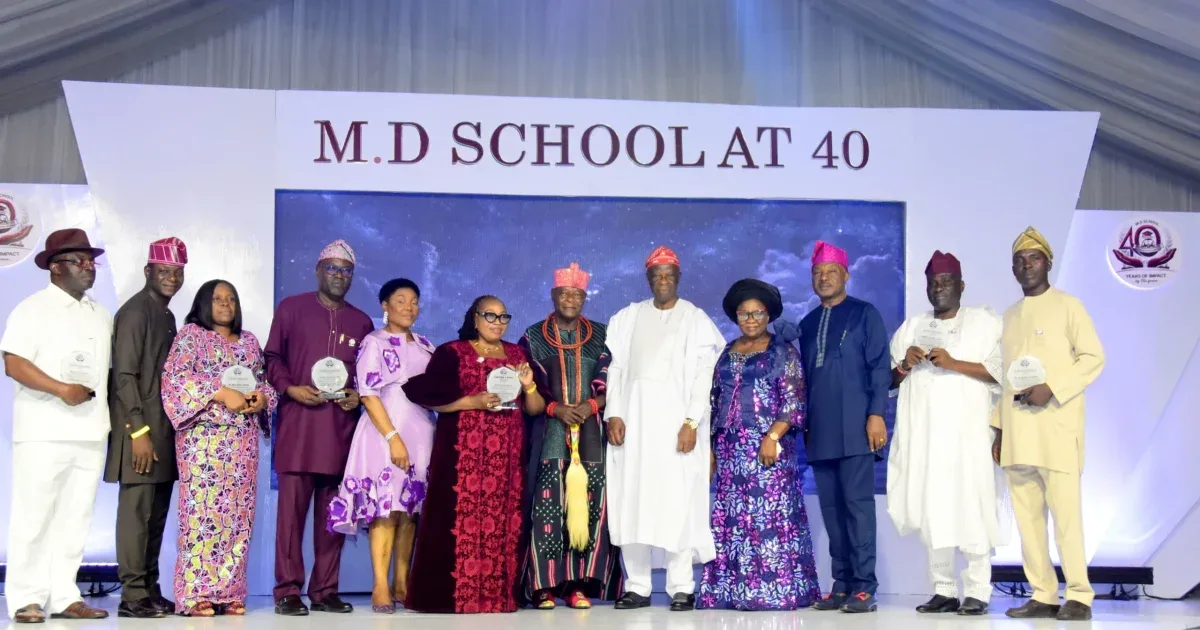
She made the remarks during the celebration of M.D School’s 40th anniversary in Lagos, where she reflected on the institution’s journey and the challenges of sustaining inclusive education in Nigeria.
According to her, the limited number of qualified special education teachers has become a major obstacle for institutions seeking to provide appropriate learning support. She explained that some available specialists prefer working directly with families and charging hourly fees rather than accepting full-time positions in schools.
Adedugbe said the situation had placed additional financial pressure on institutions like hers, forcing her to gradually reduce some of its special education activities because of limited resources.
She also recounted the difficulties the school experienced when it was established in 1986. Although the institution was founded on the principle of bringing children with and without special needs together in the same learning environment, some parents initially resisted enrolling their children alongside pupils with disabilities.
According to Adedugbe, the negative attitudes and stigma surrounding special needs education eventually forced the school to separate its regular and special education sections in 1988.
She explained that the institution later adopted the name M.D School (Inclusive) in an effort to reduce the stigma associated with its earlier identity.
The school executive director disclosed that the current proportion of pupils with special needs to regular pupils was approximately one to 50, a situation she linked partly to the loss of facilities that had previously supported its specialised programmes.
She recalled that her late husband, Bamidele Adedugbe, a clinical audiologist who provided specialist support for the children, played an important role in the school's early development.
His clinic had provided additional space for children who travelled from different parts of the country, including Kano, Abuja and Port Harcourt, to receive support. However, following his death about 10 years after the school's establishment, the facility was no longer available, making it difficult to continue providing the same level of accommodation and services.
Adedugbe also recalled the financial difficulties involved in establishing the institution, revealing that her husband once used laboratory equipment as collateral to secure a ₦120,000 loan from the now-defunct Universal Trust Bank.
Despite the challenges, she expressed satisfaction that the school's pioneering efforts had encouraged the development of other institutions providing education and support for children with special needs.
She called on government agencies, parents, non-governmental organisations and other stakeholders to work together to improve access to inclusive education.
Adedugbe stressed that neurodivergence and developmental differences should not be treated as a curse or a reason to discriminate against children, urging society to replace stigma with understanding and support.
The anniversary celebration was chaired by former Attorney-General of the Federation, Akin Olujinmi, who commended Adedugbe for sustaining the institution despite financial and regulatory challenges.
Olujinmi praised her determination to preserve the vision behind the school, noting that building and maintaining an educational institution required resilience, commitment and the ability to overcome difficult circumstances.
The Director-General of the Lagos State Office of Education Quality Assurance, Dr Sulaimon Ogunmuyiwa, also commended the school for its contribution to education and character development. He encouraged its management to maintain high educational standards.
The Chairman of the school's Governing Council, Professor Adesola Adeosun, reaffirmed the institution's commitment to helping pupils develop their abilities through dedication, optimism and hard work.
The celebration featured performances, drama, music and recitations by current pupils, with alumni also participating in some of the presentations.
After four decades, the school says its commitment to inclusive education remains central to its mission, even as staffing and funding challenges continue to test the sustainability of specialised learning services in Nigeria.
Reporting by TalkNaijaMedia



Reader Comments (0)
No comments yet. Be the first to share your perspective on this report.