

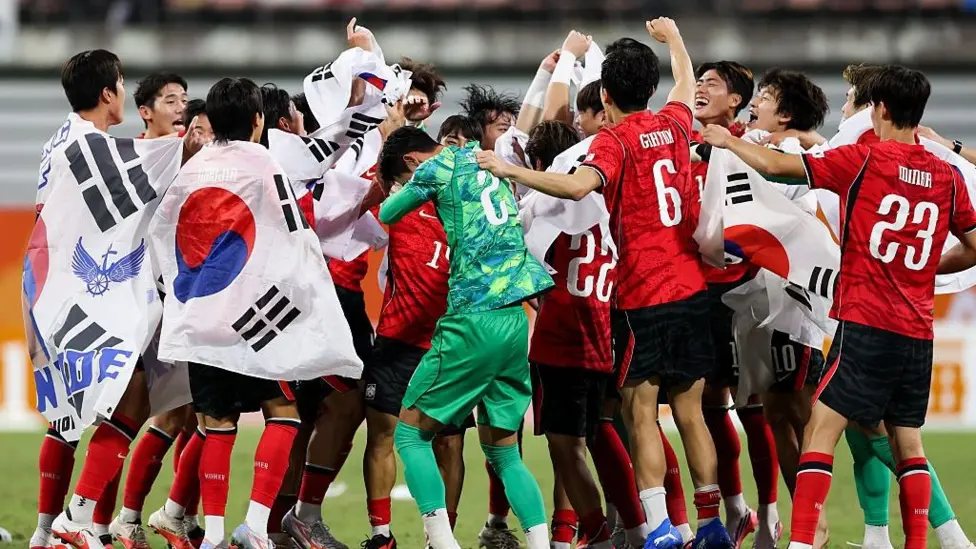
The controversy erupted after South Korea defeated hosts Japan 1–0 in the men’s football final on October 3, securing a fourth consecutive Asian Games gold medal.
The victory made 20 of the 23 players in South Korea’s squad eligible for the military service benefit, which allows qualifying athletes to avoid regular compulsory military service and instead complete alternative requirements.
The issue gained wider attention after captain Lee Gi-hyuk held up his gold medal following the final and remarked that he would not have to serve in the military.
Lee later apologised for the comment, while other players also faced criticism over remarks and social media posts that appeared to focus heavily on the military benefit attached to their victory.
South Korea’s mandatory military service system generally requires able-bodied men to complete between 18 and 21 months of service. Under the existing sports-related arrangement, Asian Games gold medallists and Olympic medallists who meet the criteria can instead be assigned to alternative service, including basic military training and community-service obligations.
The controversy has now prompted government officials to reconsider whether the system remains appropriate.
Culture, Sports and Tourism Minister Choi Hwi-young said the benefit had historically helped outstanding athletes and artists continue developing their careers, but acknowledged that public attitudes towards fairness and military service had changed.
The Defence Ministry has gone further, indicating that the government intends to gradually reduce the system and ultimately abolish the special exemption arrangement for athletes and artists.
The debate is not limited to football.
South Korea’s baseball team also came under scrutiny after winning gold at the Asian Games. The wider controversy has revived questions about whether sporting achievements at particular competitions should determine who receives an alternative to regular military service.
Critics have also questioned whether the current criteria treat achievements across different sports consistently. The issue is particularly sensitive in a country where military service remains a legal obligation for most eligible men.
The football team’s victory itself remains a major sporting achievement. South Korea scored the only goal of the final through Eom Ji-sung in the 61st minute, beating Japan to claim its fourth straight Asian Games football title.
For the players who qualified for the benefit, the outcome also has significant implications for their professional careers. Several members of the squad play overseas, and avoiding a lengthy interruption for military service could allow them to maintain their development and club careers without the disruption that regular enlistment could cause.
However, the government has not yet introduced a final replacement framework for the existing system. The current debate centres on whether the exemptions should be reduced, redesigned or eventually removed altogether.
The controversy surrounding the Asian Games football team has therefore reopened a much broader national discussion about military obligations, sporting achievement and equal treatment among young South Koreans.
Reporting by TalkNaijaMedia



Reader Comments (0)
No comments yet. Be the first to share your perspective on this report.