

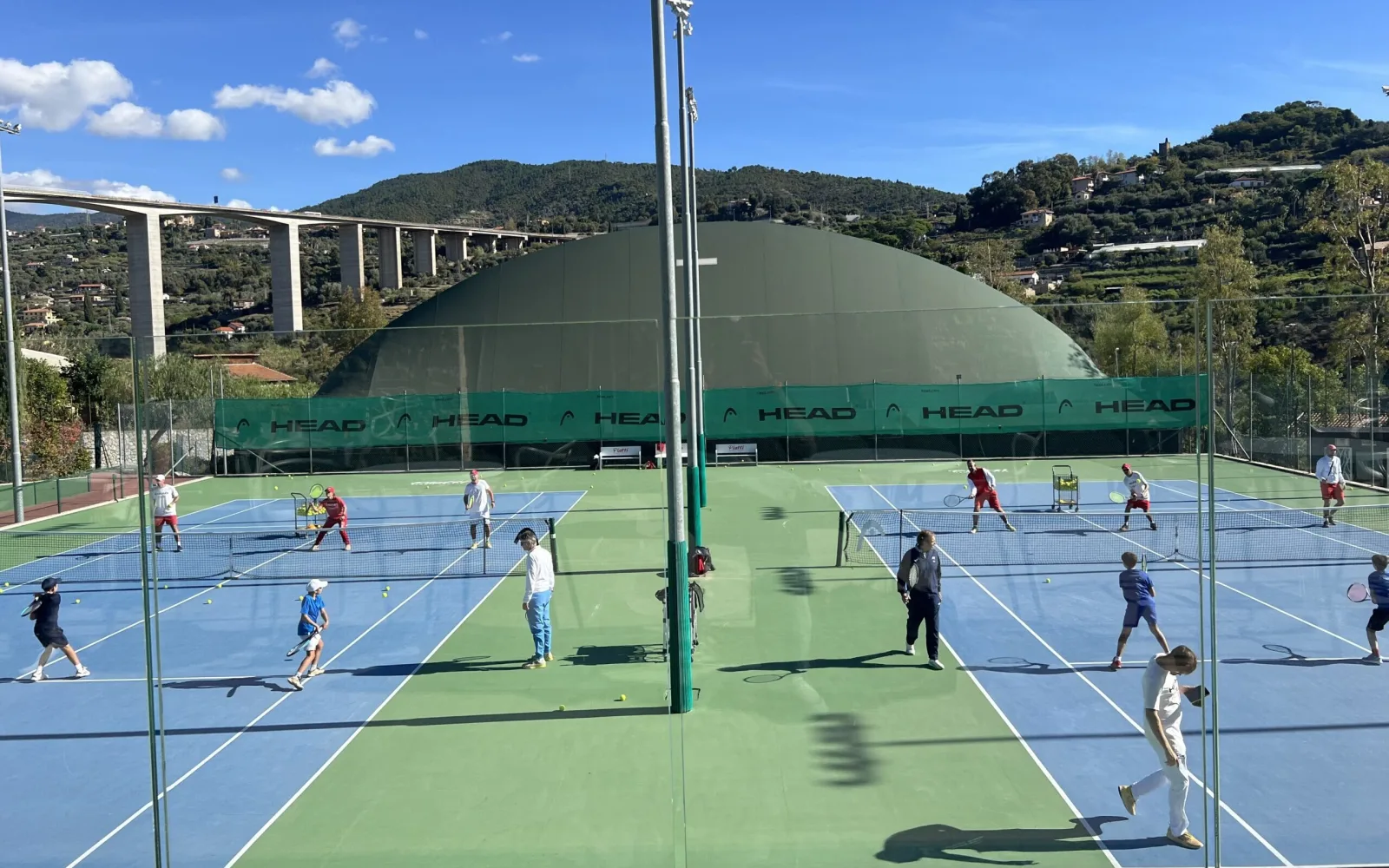
Rather than relying solely on court facilities, the academy combines technical coaching, physical conditioning, mental preparation and professional support to help young talents progress towards competitive tennis.
Its facilities include two covered hard courts, a gym, a sauna, a recovery pool, a video analysis room and treatment facilities. Players also receive support from tennis coaches, fitness trainers, health professionals and mental coaching specialists.
The centre uses video analysis to help players and coaches examine performance, identify areas requiring improvement and develop better strategies for competition. This approach ensures that training goes beyond repetitive practice and focuses on the different skills needed to succeed at professional level.
Through an agreement with the nearby Bordighera Lawn Tennis Club, players also have access to two clay courts throughout the year.
The historic club, established in 1878, is recognised as Italy’s oldest tennis club and has contributed to Bordighera’s long-standing connection with the sport.
One of the most prominent names associated with the Piatti Tennis Centre is Jannik Sinner, who went on to become one of the leading players in international tennis.
Sinner moved to Bordighera at the age of 13 to train under Piatti and other coaches. He spent several important developmental years in the area, progressing from a promising young talent to an established professional. His working relationship with Piatti ended in February 2022.
Sinner’s development highlights the importance of a structured training environment, consistent coaching, discipline and the ability to prepare athletes mentally and physically for the demands of elite competition.
For Nigeria, the centre provides useful lessons about the future of tennis development.
There is often a tendency to measure the strength of a tennis academy by the number of courts it possesses. While infrastructure is important, the experience of the Piatti Tennis Centre shows that facilities alone do not guarantee the production of successful players.
The quality of coaching, availability of experienced trainers, access to medical and recovery support, performance analysis and a clear development pathway are equally important.
An academy may have numerous courts but still struggle to produce competitive players if it lacks qualified personnel, proper training systems and long-term development plans. On the other hand, a smaller facility can achieve impressive results when its resources are organised around a strong philosophy.
Nigeria therefore needs to look beyond the construction of additional tennis courts and invest in the people and systems required to make those facilities effective.
This includes developing qualified coaches, improving access to sports science and physiotherapy, introducing modern performance-analysis tools and creating opportunities for talented young players to compete internationally.
The country also needs a structured pathway that allows promising players to progress from grassroots tennis to national and international competitions without losing the support required to sustain their development.
The Piatti Tennis Centre demonstrates that the real strength of a tennis academy is not determined by the size of its facilities alone, but by the quality of the coaching, support systems and development opportunities available to its players.
For Nigerian tennis, that is a lesson worth taking seriously.
Reporting by TalkNaijaMedia





Reader Comments (0)
No comments yet. Be the first to share your perspective on this report.