

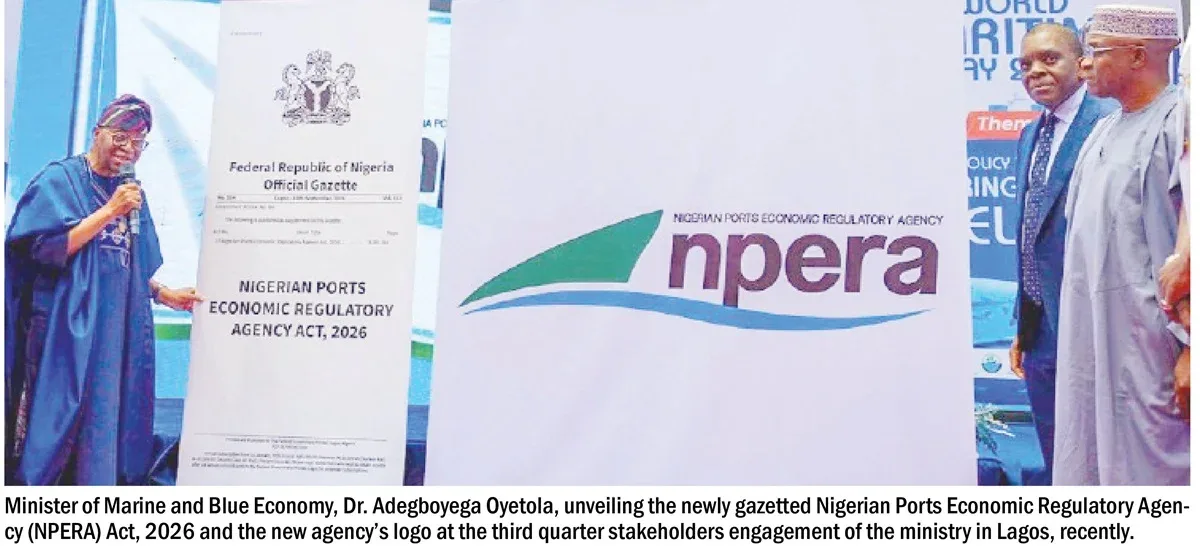
The minister said the new law provides a statutory foundation for port economic regulation after years of efforts to establish a dedicated regulatory framework. President Bola Ahmed Tinubu assented to the NPERA Act in June 2026.
Oyetola also disclosed that he had directed the formation of a ministerial committee to oversee the transition from the Nigerian Shippers’ Council to the new regulatory structure.
Under the Act, NPERA is expected to oversee port tariffs and charges, promote fair competition, enforce service standards, resolve commercial disputes and safeguard the interests of port users.
The minister stressed that the agency must operate independently and impartially, without conflicting regulatory or operational responsibilities that could undermine public confidence in its decisions.
He said effective regulation would be essential to building investor confidence, improving transparency and creating a more predictable business environment for shipping companies, terminal operators, importers, exporters and other participants in the port industry.
On maritime security, Oyetola highlighted what he described as progress in tackling piracy in Nigerian waters through the Federal Government’s Deep Blue Project. He also pointed to the lifting of a United States Coast Guard Condition of Entry requirement affecting vessels arriving from Nigeria in August 2026 as an important development for the country’s maritime reputation.
The minister said the development reflected improvements in maritime security and compliance with international ship and port facility security standards.
Oyetola also reaffirmed the government’s commitment to strengthening indigenous shipping capacity through the Cabotage Vessel Financing Fund. He said he had directed the Nigerian Maritime Administration and Safety Agency to work with approved Primary Lending Institutions to speed up the processing and disbursement of funds to eligible applicants.
The financing scheme is intended to support qualified Nigerian operators and encourage greater local participation in domestic maritime transportation. However, the minister’s directive concerns accelerating the process and does not, by itself, establish that all eligible applicants have received funding.
On international cooperation, Oyetola highlighted Nigeria’s election to Category C of the International Maritime Organization Council in November 2025, alongside ongoing engagements with Denmark, India, Norway and the United Kingdom.
He said international partnerships should produce practical benefits by strengthening local expertise, encouraging technology transfer and supporting sustainable development in Nigeria’s marine and blue economy.
The engagement also featured a presentation by Denmark’s Ambassador to Nigeria, Jens Ole Bach Hansen, on Denmark’s experience in developing a sustainable blue economy and the lessons Nigeria could draw from its approach to investment, strategic partnerships and technology transfer.
The unveiling of the NPERA Act and logo marks an important institutional step in the development of Nigeria’s port regulatory framework. The agency’s impact, however, will depend on how effectively it implements its mandate, maintains regulatory independence, resolves disputes and ensures fair and transparent treatment of port users.
Reporting by TalkNaija Media





Reader Comments (0)
No comments yet. Be the first to share your perspective on this report.