

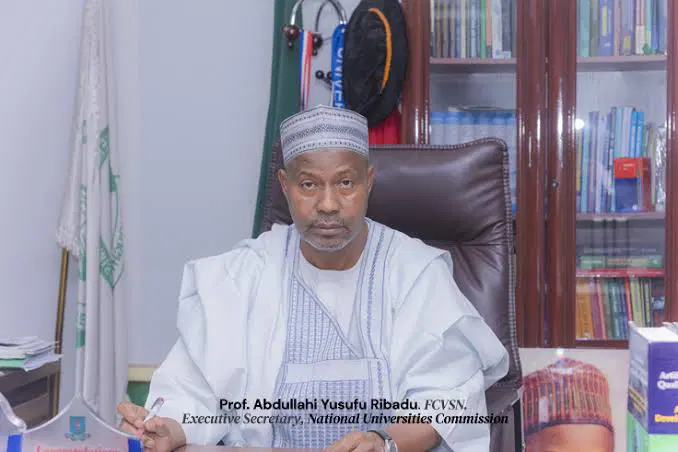
The retreat, which runs from October 13 to 14, is focused on regulatory compliance, governance, leadership and partnerships within Nigeria’s university system.
Ribadu said the commission had introduced post-matriculation monitoring and carrying-capacity visits to assess admission processes and help ensure that universities operate within their approved capacity. The NUC is also preparing to introduce post-accreditation monitoring visits to check whether institutions continue to maintain required academic standards after their programmes have been accredited.
Another measure under development is accreditation software intended to improve transparency, data management and the efficiency of regulatory procedures.
The commission is also preparing new guidelines governing the award and use of honorary doctorate degrees, including sanctions for universities that fail to comply with the rules.
Speaking at the retreat, Minister of State for Education, Professor Suwaiba Said Ahmad, stressed that stronger regulation must be accompanied by transparent university administration and closer cooperation between the NUC and institutional leaders.
Ahmad said university managements must demonstrate accountability in areas including financial management, procurement, staff recruitment and promotion, admissions and examinations. She urged vice-chancellors to set clear institutional priorities, establish measurable targets and ensure that decisions follow established procedures.
She also called for responsible adoption of artificial intelligence (AI) and other emerging technologies, warning that digital transformation must protect academic integrity, ethics and data privacy.
Ribadu said the commission was developing a national AI roadmap and policy framework for the Nigerian University System. The proposed framework is expected to guide universities in adopting emerging technologies in ways that support teaching, research and national development.
He also disclosed that the NUC had deployed its e-NUC platform to automate its internal workflows, while work on the accreditation software was continuing. He said technology investments must be supported by staff training, cybersecurity measures and appropriate institutional policies.
On wider reforms, Ribadu said the NUC Policy Development and Advisory Committee had completed Blueprint 2.0, a policy framework for revitalising Nigerian university education. The commission is also developing a longer-term strategic plan and moving from its Annual Performance Evaluation approach to a Performance Monitoring System.
The NUC chief urged university leaders to strengthen institutional planning and ensure that policies are implemented and monitored rather than left as proposals.
Research and innovation were also central to the commission’s plans. Ribadu called for stronger links between universities, government and industry so that research findings could be translated into practical products, services and solutions.
He identified agriculture, healthcare, education, technology, manufacturing, environmental protection and the creative industries as areas where university research could deliver economic and social benefits.
According to Ribadu, the commission has launched the ACE Alliance platform to improve collaboration among Nigeria’s 20 African Centres of Excellence and published a four-volume collection documenting research outputs from the centres.
He also said the Tertiary Education Research and Application Services platform operated by the Tertiary Education Trust Fund had been integrated with the Nigerian Research and Education Network to support research collaboration.
The NUC is further working to establish a Research Commercialisation Division to help protect intellectual property and support the development of marketable products from viable research findings. Plans are also underway for selected vice-chancellors to study research commercialisation practices at universities in Europe and Asia.
Acknowledging funding constraints across the university system, Ribadu encouraged institutions to explore partnerships with private companies, alumni associations and development organisations, while ensuring that such arrangements comply with regulations and serve institutional needs.
He cited partnerships with the World Bank, Agence Française de Développement and African Development Bank as part of efforts to attract additional support for university development.
Earlier, the retreat’s Local Organising Committee chairman, Lawal Mohammed Faruk, said the gathering was intended to improve engagement between the NUC and university leaders, strengthen quality assurance and promote effective governance and strategic partnerships.
The retreat is expected to produce a communiqué outlining agreed actions and institutional commitments. A proposed post-retreat monitoring and feedback mechanism is intended to track progress and encourage implementation.
The reforms come as Nigerian universities face pressure to improve academic quality, expand research impact and prepare graduates for an economy increasingly shaped by digital technologies and changing workforce needs.
Reporting by TalkNaijaMedia





Reader Comments (0)
No comments yet. Be the first to share your perspective on this report.