

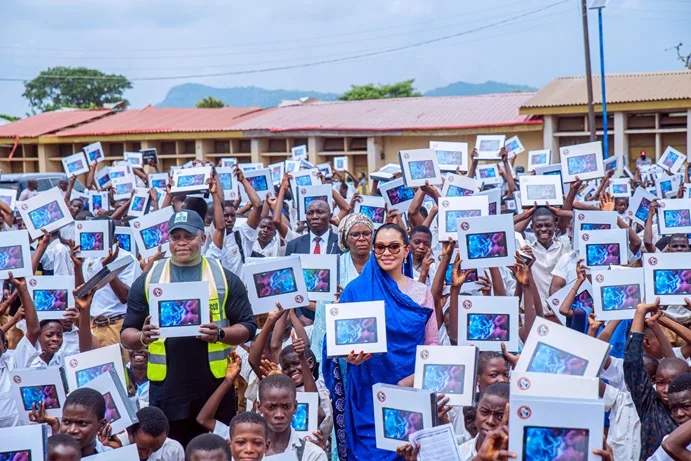
However, beyond the publicity surrounding political projects, their real value lies in whether they deliver lasting benefits, reach their intended beneficiaries and remain functional long after their commissioning or distribution.
One of the prominent initiatives featured in the report is the distribution of locally manufactured electric vehicles, including tricycles, pickup vehicles and motorcycles. Women, farmers and transport operators were among the reported beneficiaries, although the precise number of recipients requires independent confirmation.
With fuel and transportation costs placing pressure on households and businesses, electric vehicles could offer an alternative for commercial operators and people whose livelihoods depend on moving goods and passengers. Farmers, for instance, need affordable transportation to get their produce to market, while transport operators must manage running costs to remain profitable.
Electric mobility can reduce dependence on petrol, but the actual savings depend on charging access, battery life, maintenance costs and the availability of spare parts. The long-term impact of the initiative will therefore depend on whether beneficiaries can keep the vehicles operational and use them to generate sustainable income.
The reported distribution of business and trade equipment to 2,000 constituents represents another significant part of the empowerment programme. Items listed include deep freezers, gas cookers, sewing machines, grinding machines, pesticide-spraying equipment, fish ponds and cobbler machines.
Such equipment can help artisans, traders and farmers establish businesses or expand existing operations. A sewing machine may give a tailor the means to accept more orders, while a freezer can support food storage and sales. Grinding machines can provide neighbourhood services, and agricultural equipment can assist farmers with crop management.
For people who lack the capital to purchase essential tools, this kind of support can help reduce the initial cost of starting a business. However, equipment distribution alone does not guarantee commercial success. Training, access to customers, business-management skills and continued technical support are also important in helping beneficiaries turn the items into dependable sources of income.
The report also highlights the provision of drone technology kits to 250 young people and 10 tertiary institutions across Nigeria. The initiative is intended to support learning and practical work in fields such as geology and environmental science, where drones can be used for mapping, surveying and environmental monitoring.
Access to this technology could expose students to practical skills relevant to research and emerging technical careers. Its educational impact, however, will depend on the availability of trained instructors, suitable software, practical exercises and arrangements for maintaining the equipment.
Infrastructure development forms another part of the projects attributed to the senator. The report lists two modern markets, each reportedly containing 80 shops and equipped with facilities such as water, electricity and toilets.
Well-maintained markets can improve trading conditions, support local commerce and provide a more organised environment for buyers and sellers. Reliable water and electricity can also make commercial activities more convenient. The ultimate benefit will depend on how the markets are managed, whether traders can access the shops on fair terms and whether the facilities remain functional.
In education, the report identifies a new primary school, a secondary school and teachers’ quarters in Osaraba community. These facilities could improve access to learning and help address accommodation challenges for teachers in underserved areas.
Nevertheless, school buildings must be supported by qualified teachers, learning materials, effective administration and regular maintenance. Sustained cooperation with the relevant education authorities will be essential to ensure that the facilities translate into improved learning opportunities.
Electricity and water supply also feature prominently in the reported interventions. The projects include eight 500 KVA ABB transformers and 14 solar-powered water-reticulation systems. If properly installed and maintained, the transformers could help strengthen electricity distribution, while solar-powered water systems could improve access to water in communities where supply remains a challenge.
Their effectiveness cannot be measured by the number of units supplied alone. The transformers must be connected to a functioning distribution network, while water systems require reliable water sources, appropriate treatment where necessary and regular servicing.
The report further lists 2,000 smart solar-powered streetlights across five local government areas. Streetlighting can improve visibility at night and make roads and public spaces easier to use for residents, traders and commuters. Whether the installations have improved public safety will require evidence from the communities concerned rather than assumptions based on the presence of the lights.
Support for local security infrastructure is also mentioned, including police housing quarters, a patrol van and a speed bike for the police station in Ihima. Such resources could strengthen operational capacity, but their impact depends on adequate staffing, funding, maintenance and coordination with other security agencies.
Beyond the physical projects, the senator’s public profile has also prompted discussion about religious tolerance and inclusive representation.
Akpoti-Uduaghan is a Christian representing Kogi Central, a district with a substantial Muslim population. Her family background, as described in the source report, reflects religious diversity: her father was Muslim, her mother is Christian, and she chose Christianity.
Her election illustrates an important democratic principle: political representation should be determined by voters’ choices and confidence in a candidate, rather than by an expectation that an elected official must share the dominant religion of the constituency.
Public services such as roads, schools, markets, electricity, water and security are essential to people regardless of their faith. Elected officials therefore have a responsibility to serve constituents fairly across religious, ethnic and social boundaries.
Some supporters have described Akpoti-Uduaghan as an ambassador of multicultural harmony. While the label reflects a positive ideal, the strongest demonstration of religious tolerance comes through consistent inclusion, fair access to public resources and respect for people of different beliefs.
The broader assessment of the senator’s constituency projects must also go beyond announcements and photographs. It is important to establish how many beneficiaries have built sustainable businesses, how many distributed vehicles remain operational, whether the markets are functioning and whether the schools, transformers, water systems and streetlights are delivering their intended benefits.
Transparent beneficiary records, independent assessments and regular updates would help the public understand the reach and effectiveness of the interventions. Such scrutiny is not intended to dismiss the projects, but to distinguish initial delivery from lasting impact and identify areas requiring further attention.
There is also an opportunity for the projects to be strengthened through collaboration with state and local governments, private businesses, educational institutions and community organisations. Such partnerships could help improve maintenance, expand access to technical support and connect small businesses with wider markets.
Ultimately, the measure of representation is not simply the number of projects announced or the equipment distributed. It is whether those interventions improve livelihoods, strengthen public services and create opportunities that endure.
For Kogi Central, the projects attributed to Akpoti-Uduaghan raise important questions about how constituency development can support economic empowerment while encouraging unity across religious differences. Their lasting significance will depend on transparent implementation, sustained maintenance and fair access for the people they are intended to serve.
Reporting by TalkNaija Media



Reader Comments (0)
No comments yet. Be the first to share your perspective on this report.