

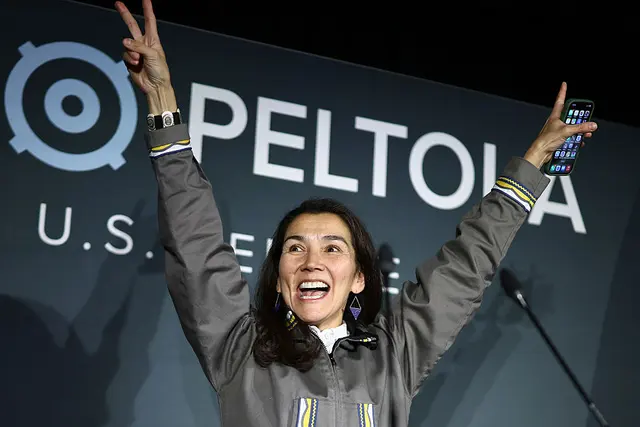
With the victory, Democrats are set to control 56 seats in the 100-member Senate against 44 for Republicans when the new Congress begins in January 2027. The party flipped nine Republican-held seats during the midterm elections.
Results reported by US election networks showed Peltola with approximately 50.1 per cent of first-choice votes, compared with 45.8 per cent for Sullivan. Gerald Heikes received about 2.1 per cent, while Daniel J. Sullivan Jr., an unaffiliated candidate whose name became central to the controversy surrounding the election, polled approximately 1.7 per cent.
Peltola's share crossed the 50 per cent threshold required to win outright under Alaska's ranked-choice voting system, meaning election officials would not need to conduct further rounds of vote transfers to determine the projected winner.
The contest attracted national attention following allegations that political operatives linked to Democratic interests had helped recruit another candidate bearing a name similar to that of the Republican incumbent.
An investigation published by The New York Times on October 28 reported that individuals connected to Peltola's campaign, her legal team and senior Democratic Senatorial Campaign Committee officials had been involved in discussions about recruiting Republican challengers to enter the race.
One of the candidates was Daniel J. Sullivan Jr., whose name closely resembles that of incumbent Senator Dan S. Sullivan. The reported strategy, described as a ballot-composition effort, was allegedly intended to divide support for the Republican senator and improve Peltola's chances.
Peltola's campaign denied involvement in recruiting the candidates, rejecting suggestions that it had orchestrated the effort to influence the outcome.
The controversy also drew the attention of President Donald Trump, who accused Peltola of election-related wrongdoing and called for action against her.
The US Department of Justice subsequently filed a lawsuit seeking to prevent Alaska from certifying the election under circumstances where votes for the similarly named candidate could potentially affect the result.
However, a federal judge dismissed the case on November 1, ruling against the administration's attempt to delay certification. The Justice Department appealed the decision, while a separate investigation into the alleged recruitment effort remained ongoing.
Despite the legal dispute and political accusations, Peltola secured enough first-choice votes to cross the required majority threshold, giving her a clear path to victory without relying on redistributed preferences.
Her election marks a significant political milestone for Alaska. She becomes the first Democrat elected to represent the state in the US Senate since Mark Begich won in 2008 and the first Alaska Native person elected to the chamber.
Peltola previously represented Alaska in the US House of Representatives from 2022 to 2025, becoming the first Alaska Native woman elected to Congress.
During her Senate campaign, she focused on the cost of living, healthcare expenses, housing, energy and the economic concerns of Alaska residents. She also presented herself as a candidate prepared to prioritise the state's interests rather than simply follow national party positions.
Her victory completes the outstanding Senate race in the 2026 midterm elections and gives Democrats a substantially stronger position in the chamber ahead of the next congressional session.
The result is also a major setback for Republicans, who will enter the new Congress with a reduced Senate presence after losing several seats in states previously considered favourable to the party.
Although the projected outcome has settled the contest between Peltola and Sullivan, the remaining legal and investigative proceedings surrounding the candidate-recruitment allegations are separate matters and do not, by themselves, establish that election fraud occurred.
Reporting by TalkNaijaMedia




Reader Comments (0)
No comments yet. Be the first to share your perspective on this report.