

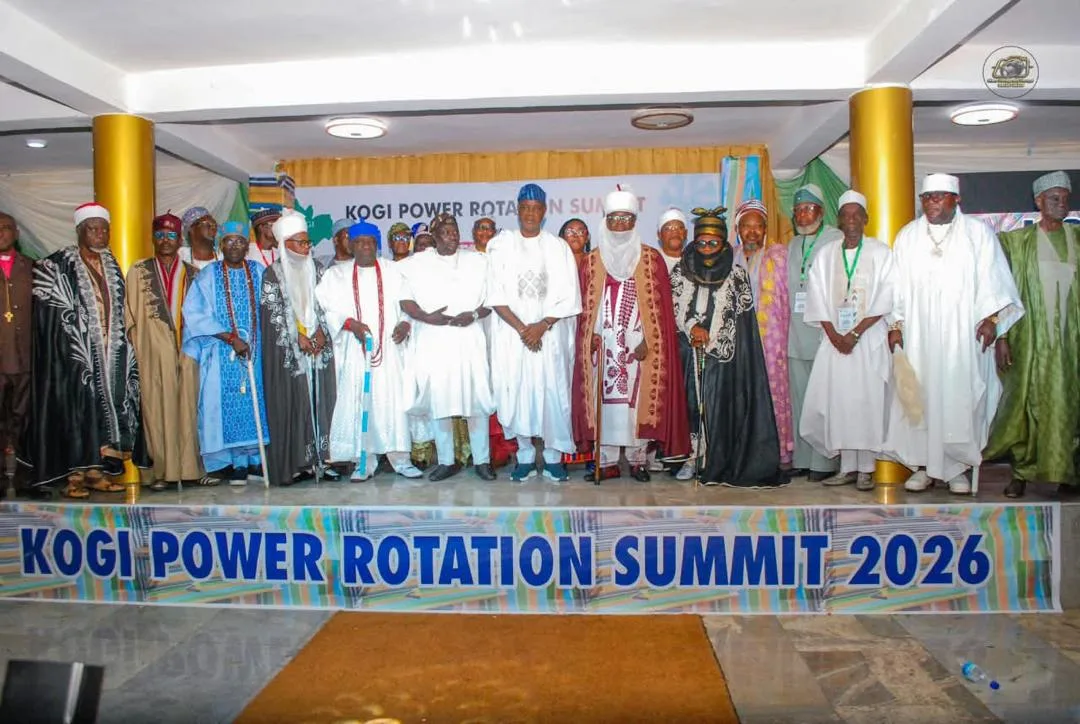
Stakeholders drawn from Kogi State’s three senatorial districts have renewed the debate over political power rotation, with the majority position at the maiden Kogi Power Rotation Summit favouring the commencement of an eight-year rotational arrangement in 2032.
The position was contained in the communiqué issued after the two-day summit held on September 30 and October 1, 2026, at the K Galaxy Event Centre in Lokoja. The summit, organised by the Kogi Unity Accord under the theme, “Retooling Kogi for Unity, Equity and Shared Prosperity,” brought together traditional rulers, religious leaders, political stakeholders, community and socio-cultural organisations, professionals, labour representatives, youths, students and civil society groups.
According to reports on the communiqué, most of the views presented at the meeting supported an eight-year rotation of political power, with 2032 proposed as the commencement date. The proposed timeline would allow room for further consultations, possible legislation and the development of a legal or institutional framework for the arrangement.
The 2032 proposal would also mean that the current administration of Governor Ahmed Usman Ododo would be allowed to complete a second term before the proposed rotation takes effect. It is important, however, to note that the summit’s position is a stakeholder proposal and does not itself guarantee or confer a second term on the governor. Any future governorship election remains subject to Nigeria’s constitutional and electoral processes.
The summit described power rotation as a possible mechanism for promoting fairness, unity, peaceful coexistence and a stronger sense of belonging among Kogi residents. At the same time, the communiqué stressed that rotation should not replace considerations such as competence, integrity, capacity and accountability.
Participants also called for a broad framework that would promote political inclusion and equitable participation across Kogi East, Kogi Central and Kogi West. Further consultations among the three senatorial districts were recommended before any final position is reached.
The issue of which zone should take the next turn nevertheless remained contested.
Some delegates and organisations argued that political power should move to Kogi West after the expiration of the current administration. Rotimi Akenson, President of the Okun Development Association, made the case for an Okun candidate, pointing to the fact that Kogi West has not produced an elected governor since Kogi State was created in 1991. That position is a political argument advanced by Kogi West stakeholders rather than an existing constitutional entitlement.
A representative of the Christian Association of Nigeria also supported a rotational arrangement that would move power to Kogi West after the incumbent’s tenure, while expressing a preference for a Christian governor based on what the representative described as ethnic and religious considerations. The views illustrate the differences that remain over both the timing and structure of any proposed rotation.
One of the major developments from the summit came from the Kogi State House of Assembly. Speaker Aliyu Umar Yusuf said the legislature was prepared to pursue legislation that could provide an institutional framework for power rotation in the state.
The Speaker's position is not entirely new. The Assembly had previously discussed the possibility of providing legislative backing for rotation among the three senatorial districts. However, his latest remarks at the summit have renewed attention on the possibility of moving the debate from political convention and advocacy towards a formal legislative process.
Any such legislation would still have to comply with the Nigerian Constitution and applicable electoral laws. Reports from the summit noted that the 1999 Constitution, as amended, does not expressly require the governorship of a state to rotate among senatorial districts. The communiqué therefore called for any eventual framework to operate within lawful democratic and institutional processes.
Governor Ahmed Usman Ododo, who was represented at the summit by the State Security Adviser, Commodore Jerry Omodara (retd.), urged participants to pursue political discussions without threatening the peace of the state.
The governor's message focused on dialogue, unity and peaceful political engagement. He said Kogi's diversity should be treated as a strength and encouraged young people in particular to reject political violence as stakeholders discuss the state's political future.
The summit chairman, Vice Admiral Joseph Ajayi (retd.), described the dialogue as significant to the state's political development and called for a structured approach that could promote inclusion while reducing tensions associated with political competition and power-sharing.
Participants also proposed a Kogi Charter of Equity and Inclusion to guide political participation, representation and peaceful engagement across the state. Other recommendations included a follow-up mechanism, wider consultations, stronger structures for the Kogi Unity Accord and continued involvement of traditional rulers, religious leaders, women, youths, professionals, political actors and community organisations.
The summit further called for attention to minority communities and equitable representation in political appointments and participation.
For now, the outcome leaves Kogi's power-rotation debate with several positions on the table: the majority view recorded at the summit favours an eight-year arrangement beginning in 2032, while some stakeholders want the next transition to go to Kogi West after the incumbent's tenure.
The summit therefore appears to have advanced the conversation rather than settled it. Further consultations, political negotiations and any proposed legislative process will determine whether the ideas discussed in Lokoja eventually develop into a formal framework for power sharing in Kogi State.
Reporting by TalkNaijaMedia



Reader Comments (0)
No comments yet. Be the first to share your perspective on this report.