

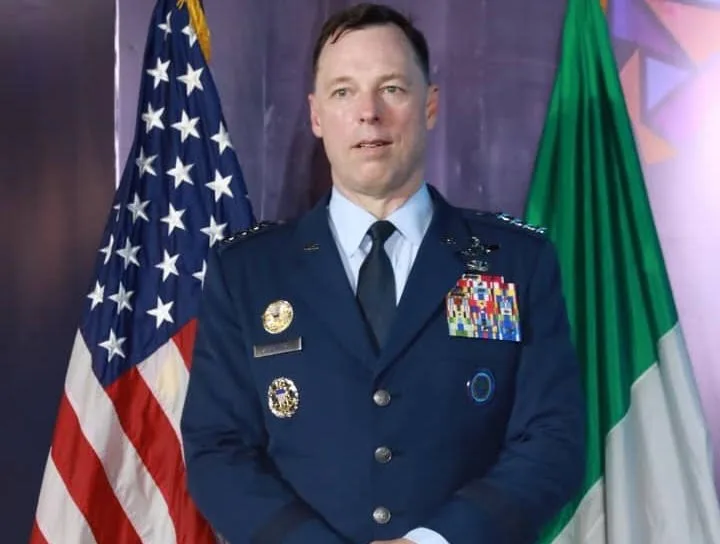
He said the development suggested that some members of the terrorist group were reconsidering their involvement as security operations continued to disrupt its leadership and networks.
The AFRICOM commander praised cooperation between the Nigerian Armed Forces, intelligence agencies and their American counterparts, describing the partnership as central to the operation conducted in northeastern Nigeria on May 16, 2026.
The operation targeted al-Minuki, whom US and Nigerian authorities identified as a senior ISIS leader involved in coordinating the group's international operations. AFRICOM said several other senior militants were also killed.
Anderson said Nigeria had continued conducting operations against ISIS since the joint mission, while the United States maintained its support through intelligence sharing, specialised capabilities and training.
He explained that the partnership combined Nigeria's knowledge of local conditions and regional security networks with America's understanding of the group's wider international connections.
According to him, the United States has also provided training in intelligence, surveillance and reconnaissance, as well as target identification, and remains open to considering further requests from Nigerian security forces.
However, Anderson cautioned that military operations alone would not resolve Nigeria's security challenges. He argued that sustainable progress also depended on improvements in governance, education, economic development and access to legitimate opportunities.
He said communities needed stronger institutions and viable economic prospects to reduce the conditions that could make young people vulnerable to recruitment by terrorist organisations and criminal networks.
The AFRICOM chief also identified terrorist financing as a major obstacle in the fight against insecurity, stressing the importance of understanding how extremist groups raise, move and conceal funds.
He said cooperation in this area could combine American intelligence and cyber capabilities with Nigeria's understanding of local financial networks and money-laundering methods.
Anderson further highlighted the need for stronger regional security cooperation following the withdrawal of Mali, Burkina Faso and Niger from the Economic Community of West African States (ECOWAS).
The three countries subsequently established the Alliance of Sahel States (AES), a regional bloc through which they have pursued closer cooperation on security and other matters.
Anderson said the United States wanted to reopen dialogue with the three countries to improve communication and explore areas of shared interest, particularly in counterterrorism.
He noted that renewed engagement could create opportunities for intelligence sharing and training, although restoring communication would be an important first step.
On maritime security, the AFRICOM commander said the United States had supported initiatives to improve monitoring of the Gulf of Guinea and other West African waters, including maritime operations centres and radar capabilities.
He identified piracy, smuggling, drug trafficking and illegal fishing as continuing concerns for countries bordering the region's waters. However, he did not confirm plans for additional vessel acquisitions.
Assessing the impact of recent counterterrorism operations, Anderson pointed to the reported rise in ISIS defections, alongside reductions in attacks and violence, as indicators that security pressure was having an effect. He also commended Nigeria's efforts to reintegrate former fighters who leave extremist groups into society.
He said AFRICOM would continue directing its resources towards priority security threats and partners capable of working with the United States, while emphasising the importance of locally driven solutions.
Anderson also called for greater investment in opportunities for Africa's growing youth population, arguing that education, employment and productive economic activities could help communities build resilience against extremist recruitment.
His remarks highlight the two-track approach being pursued in the fight against terrorism: sustained security operations to weaken armed groups and longer-term investments in governance, development and economic opportunity to address factors that contribute to insecurity.
Reporting by TalkNaijaMedia




Reader Comments (0)
No comments yet. Be the first to share your perspective on this report.