

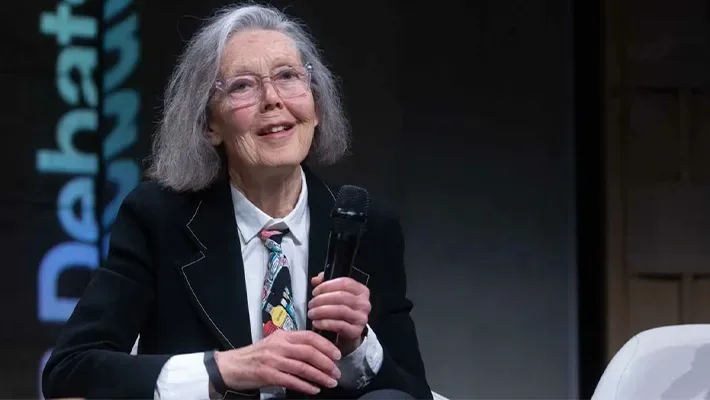
Canadian poet and essayist Anne Carson has made history after being awarded the 2026 Nobel Prize in Literature by the Swedish Academy.
Carson, 76, was announced as the laureate on Thursday, October 8, 2026, becoming the 19th woman to receive the prestigious literature award since the Nobel Prizes were first presented in 1901.
The Swedish Academy recognised Carson for her “bold and inventive oeuvre” and its playful engagement with classical traditions to create new forms for contemporary literature.
Her victory also makes her the second Canadian woman to win the Nobel Prize in Literature, following the late Alice Munro, who received the award in 2013.
Carson's achievement adds another chapter to the long history of women in the Literature category, which has been dominated numerically by male laureates.
The first woman to win the Literature Nobel was Swedish writer Selma Lagerlöf, who received the prize in 1909. It took another 17 years before an additional woman joined the list, when Italian writer Grazia Deledda won in 1926.
The pace of female representation remained uneven for much of the 20th century. Nelly Sachs became the sixth woman laureate when she shared the 1966 prize with Israeli writer Shmuel Yosef Agnon, while South African author Nadine Gordimer became the seventh female winner in 1991.
The number of women laureates increased more frequently in the 21st century, with major names including Doris Lessing, Herta Müller, Alice Munro, Svetlana Alexievich, Olga Tokarczuk, Louise Glück, Annie Ernaux and Han Kang joining the list.
Han Kang, who became the first South Korean writer to win the Literature Nobel, was the most recent female laureate before Carson's selection in 2026. She won the 2024 prize for prose that confronts historical trauma and explores the fragility of human life.
Carson's win also adds to Canada's history at the Nobel Prizes. Her award follows Munro's 2013 victory and makes Carson the country's second female Literature laureate.
A scholar of classical literature as well as a poet and essayist, Carson has built a reputation for crossing conventional literary boundaries. Her work draws on poetry, translation, classical texts and other forms, a quality reflected in the Swedish Academy's decision to recognise the innovative character of her writing. The University of Toronto, where Carson earned three degrees, also celebrated her Nobel victory.
The Literature Nobel has been awarded 119 times since 1901, with several years omitted from the prize schedule, including periods during the First and Second World Wars. The award has occasionally been shared by two laureates, including the notable 1966 pairing of Nelly Sachs and Shmuel Yosef Agnon.
Carson's age also places her among the more senior writers to receive the honour. The record for the youngest Literature laureate remains with Rudyard Kipling, who was 41 when he won in 1907, while Doris Lessing became the oldest at 87 when she received the prize in 2007.
From Lagerlöf's pioneering victory in 1909 to Carson's historic selection more than a century later, the list of female Nobel Literature laureates reflects a gradual, though uneven, expansion of women's representation in one of the world's most prestigious literary honours.
Carson's award now places her firmly among the women whose work has helped shape the history of the Nobel Prize in Literature.
Reporting by TalkNaijaMedia


Reader Comments (0)
No comments yet. Be the first to share your perspective on this report.