

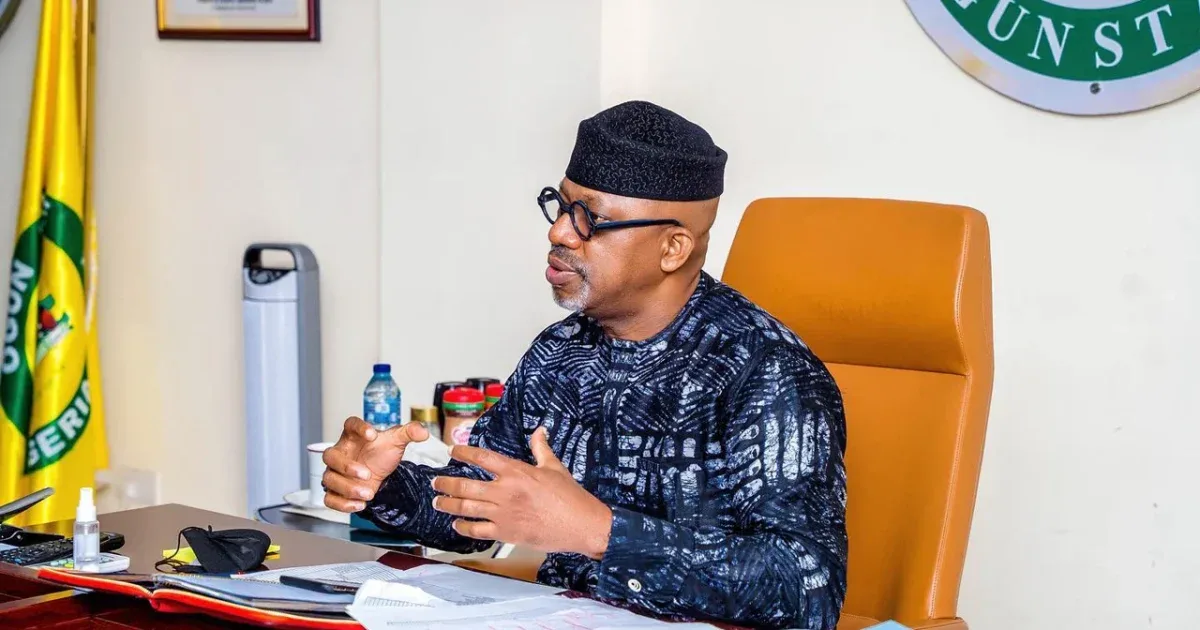
Nigeria may require an additional 554,353 personnel to adequately staff the proposed State Police system, Ogun State Governor and Chairman of the Southern Governors’ Forum, Dapo Abiodun, has said.
Abiodun made the disclosure on Thursday, October 8, 2026, while delivering the keynote address at a posthumous 70th birthday colloquium held in honour of former Ondo State Governor Oluwarotimi Akeredolu at the International Conference Centre of the University of Ibadan.
The event, organised around the theme “Fundamentals and Governance of State Policing: Towards a New Architecture for National Security in Nigeria,” brought together political leaders, security officials, lawmakers, traditional rulers, academics and other stakeholders to discuss the proposed reform and its implications for national security.
According to Abiodun, data from the Nigeria Governors’ Forum, using a United Nations benchmark of one police officer to 414 citizens, indicates that the country would need 554,353 additional personnel. He said the figure could translate to roughly 184,784 recruits each year over a three-year period.
The governor argued that the conversation had moved beyond simply debating whether State Police should be created and should now focus on how such a system could be established, funded and managed effectively.
He said policing should take greater account of local conditions, including the language, geography and specific security challenges of individual communities.
However, Abiodun warned that funding could become one of the biggest challenges facing the proposed system.
He said the financial strength of Nigerian states varies significantly, pointing to data showing that Lagos, Rivers, the Federal Capital Territory, Ogun and Enugu accounted for 61.6 per cent of Internally Generated Revenue, while a large majority of states generated below the national per-capita average cited in his presentation.
Abiodun therefore proposed the creation of a State Police Take-Off Fund to help prevent poorer states from being disadvantaged when the new structure is eventually established.
His proposed funding arrangement would include equal-access grants, additional support based on need and disbursements linked to agreed standards.
The governor also stressed that recruitment into any State Police structure would need to be transparent and properly vetted, while officers should receive professional training and operate under clear accountability mechanisms.
He said the system must also protect citizens regardless of their political affiliation, with journalists, peaceful protesters, minority groups and political opponents entitled to equal protection under the law.
Abiodun further argued that the proposed reform should include adequate welfare for officers, including regular pay, training, medical support, insurance, equipment and resources required for effective policing.
He warned that private funding should not give individuals or organisations the ability to influence police investigations or receive preferential treatment.
The governor linked the security debate directly to economic development, arguing that insecurity can affect investment, agriculture, infrastructure and other areas of economic activity.
He also credited Akeredolu with helping to move the discussion on decentralised policing from an abstract proposal towards practical regional action through the establishment of the Western Nigeria Security Network, popularly known as Amotekun, in 2020.
Ondo State Governor Lucky Aiyedatiwa said Akeredolu's advocacy for State Police had since moved beyond the Southwest and into Nigeria's wider policy and constitutional debate.
Aiyedatiwa said the major challenge would now be developing a system that is responsive to local security needs while maintaining professionalism, accountability and safeguards against abuse.
The Director-General of the Development Agenda for Western Nigeria Commission, Dr Seye Oyeleye, similarly said the debate had shifted from whether State Police should exist to questions surrounding funding, training, equipment, regulation and accountability.
Former Ekiti State Governor Kayode Fayemi also paid tribute to Akeredolu, highlighting his advocacy for a more decentralised security structure and his role in regional cooperation.
For now, State Police remains a proposed reform rather than an operational nationwide system. Its eventual implementation would require decisions on constitutional and legislative arrangements, financing, recruitment, training, command structures and safeguards for citizens' rights.
The discussions at the Ibadan colloquium therefore highlight the scale of the task ahead as Nigeria considers whether and how to introduce a more decentralised policing architecture.
Reporting by TalkNaijaMedia


Reader Comments (0)
No comments yet. Be the first to share your perspective on this report.