

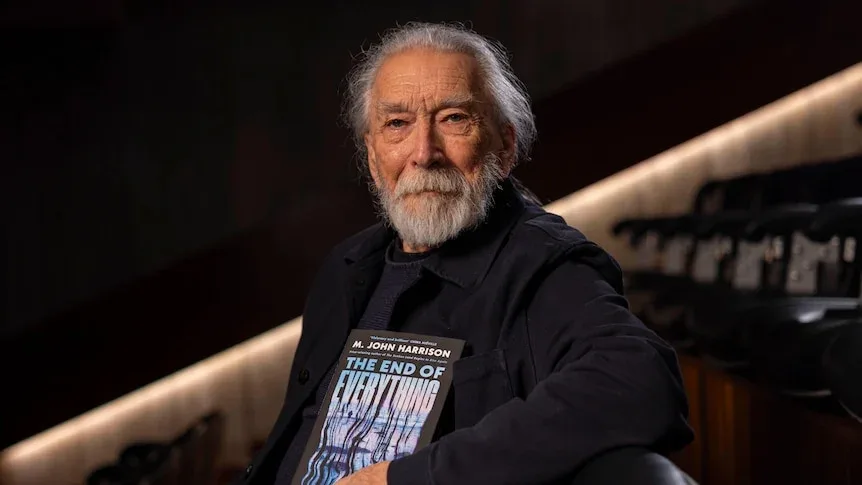
The award marks a major milestone in Harrison’s six-decade writing career and represents his first Booker Prize victory. His winning novel is also his 13th and was selected from 163 books considered by the judges.
The End of Everything follows Phillip Tennent, a man who makes a living collecting objects washed ashore along England’s southern coast, and his elderly aunt, Marnie. The story is set decades into the future, after a mysterious catastrophe and an invasion by strange entities known as the iGhetti have disrupted society.
The novel explores a world where government institutions have weakened, social order has broken down and people struggle to understand the events around them while trying to maintain ordinary lives.
Harrison said the 2008 global financial crisis helped inspire the novel, while contemporary developments influenced its themes and satire. He explained that the story examines how people continue to build lives when their expectations and understanding of the world are repeatedly challenged.
In his acceptance speech, the author admitted that he had not expected to win, describing the experience as unusual and life-changing. He also expressed appreciation to his publisher, Serpent’s Tail, and his partner, editor Cath Phillips, for their support throughout his career.
Harrison acknowledged the contribution of those who had supported his writing over several decades, noting that producing a novel was never an entirely individual effort.
The chair of the 2026 Booker Prize judging panel, classicist Mary Beard, described the winning novel as “the politics of now seen through the lens of the future”.
Beard said the judges were impressed by the book’s ability to challenge readers, combine satire with unsettling themes and still leave a sense of optimism despite its bleak setting. She also confirmed that the panel unanimously selected Harrison’s novel.
Other members of the judging panel included writer Patricia Lockwood, poet Raymond Antrobus, musician and broadcaster Jarvis Cocker, and journalist Rebecca Liu.
Harrison emerged ahead of five other shortlisted authors: Marlon James for The Disappearers, Luke Kennard for Black Bag, Rebecca Perry for May We Feed the King, Elizabeth Strout for The Things We Never Say, and Douglas Stuart for John of John.
The victory makes Harrison the oldest winner in the award’s history, surpassing the previous record held by Margaret Atwood, who was 79 when she jointly won the prize in 2019 for The Testaments.
The author is widely recognised for his contributions to science fiction and fantasy. His earlier novel, Nova Swing, won the Arthur C. Clarke Award in 2007, while The Sunken Land Begins to Rise Again received the 2020 Goldsmiths Prize.
Harrison also served as a Booker Prize judge in 2022, the year Shehan Karunatilaka won with The Seven Moons of Maali Almeida.
His 2026 victory has drawn attention to the growing acceptance of speculative and genre-blending fiction within mainstream literary recognition.
Speaking about literary labels, Harrison argued that writers should have the freedom to combine different styles and genres without being restricted by traditional classifications. He said the Booker recognition demonstrated that a novel could successfully bring together several literary approaches.
Founded in 1969, the Booker Prize recognises the best sustained work of fiction written in English and published in the United Kingdom or Ireland. It is open to authors regardless of nationality and remains one of the most prominent awards in international literature.
Reporting by TalkNaijaMedia





Reader Comments (0)
No comments yet. Be the first to share your perspective on this report.