

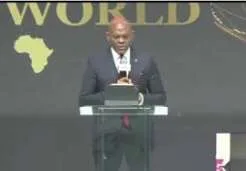
Speaking on the importance of women's participation in economic development, the chairman of Heirs Holdings recalled how his mother operated a small restaurant and worked tirelessly to provide for her children.
He explained that watching her manage the business with limited resources introduced him to essential entrepreneurial principles long before he entered the corporate world.
According to him, his earliest understanding of risk management, cash flow, customer relations, discipline and resilience came from observing how his mother handled the daily demands of running her restaurant.
Elumelu described the experience as his first business education, noting that his mother's ability to turn limited resources into a sustainable livelihood shaped his understanding of hard work and business management.
He argued that women's contributions to business and economic leadership should receive greater recognition, stressing that women already play significant roles in building enterprises but often lack the funding, authority and acknowledgement needed to expand their impact.
The businessman maintained that empowering women economically should not be treated merely as a social responsibility but as an important requirement for Africa's competitiveness and long-term prosperity.
To demonstrate the impact of women in entrepreneurship, Elumelu disclosed that 48 per cent of the 24,633 entrepreneurs supported by the Tony Elumelu Foundation over 15 years were women.
He said the foundation, established with his wife, Dr Awele Elumelu, had provided more than $120 million in seed funding to entrepreneurs across all 54 African countries.
The supported businesses, he added, had collectively generated more than $4.2 billion in revenue and created over 1.5 million jobs.
Elumelu called on governments, financial institutions, investors and private-sector organisations to make more funding and leadership opportunities available to women, arguing that Africa could not achieve inclusive economic growth while a significant portion of its talent remained underutilised.
Beyond women's economic participation, he identified unreliable electricity, limited value addition and inadequate access to capital as major obstacles slowing Africa's development.
On electricity, he argued that African countries must address persistent power challenges before they can fully benefit from industrialisation and emerging technologies such as artificial intelligence.
He explained that factories, hospitals, schools and technology-driven businesses all depend on reliable electricity and connectivity, adding that improved power supply would unlock opportunities across several sectors.
Elumelu also challenged African countries to move away from excessive dependence on exporting raw materials while importing finished products.
He called for greater investment in local processing, manufacturing, branding and distribution, saying the continent must develop the capacity to create more value from its natural resources before selling to international markets.
On financing, he urged African countries to mobilise domestic capital through savings, pension funds, insurance companies, banks and other financial institutions.
He maintained that Africa's economic future would depend increasingly on investment and trade rather than continued reliance on foreign aid.
The businessman also highlighted the enormous demand for entrepreneurship funding across the continent, revealing that the Tony Elumelu Foundation received more than 265,000 applications for its 2026 entrepreneurship programme but selected only 3,200 beneficiaries.
He said the figures demonstrated that Africa had no shortage of people willing to build businesses but faced a significant funding gap that prevented many promising ideas from receiving the support needed to grow.
The foundation's 2026 programme selected entrepreneurs from all 54 African countries, with beneficiaries receiving seed funding, business training, mentorship and access to networks.
Elumelu's remarks formed part of discussions at the WIMBIZ conference, which marked the organisation's 25th anniversary under the theme, “Rooted, Rising, Ready: Born in Africa, Built for the World.”
The gathering brought together business leaders, professionals, entrepreneurs and public-sector stakeholders to examine women's leadership, economic participation and Africa's position in the global economy.
His address reinforced the argument that Africa's development will require more than natural resources and ambitious policies. It will also depend on investing in people, expanding access to finance, improving infrastructure and creating opportunities for women and young entrepreneurs to build sustainable businesses.
Reporting by TalkNaijaMedia

Reader Comments (0)
No comments yet. Be the first to share your perspective on this report.