

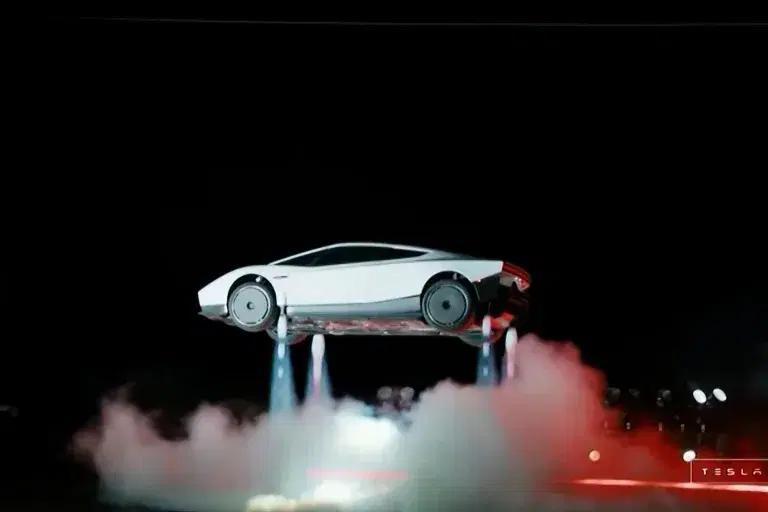
Although the demonstration has renewed interest in the possibility of flying cars, the Roadster has not been shown to sustain flight like a conventional aircraft. Its aerial capabilities remain experimental, and questions about practical use and regulatory approval persist.
Here are five key things to know about Tesla’s redesigned Roadster.
1. It features SpaceX-inspired thrusters
The new Roadster combines Tesla’s electric-vehicle technology with cold-gas thrusters developed in collaboration with SpaceX, Musk’s aerospace company.
The system uses highly pressurised gas to generate thrust, allowing the prototype to perform brief aerial movements. During the unveiling, the vehicle used the technology to rotate in mid-air and land back on its wheels.
However, the demonstration does not mean the car can travel through the air over long distances. Its flight-like performance is currently limited to brief manoeuvres demonstrated under controlled conditions.
2. Tesla claims acceleration from 0 to 60 mph in under a second
Tesla presented the Roadster as a high-performance vehicle capable of accelerating from zero to 60 miles per hour, approximately 97 kilometres per hour, in less than one second.
The company’s demonstration showed the vehicle achieving the feat in about 0.8 seconds. The figure remains a company-reported claim and has not been independently established for a production-ready vehicle.
3. It is planned in three configurations
Tesla has outlined three versions of the Roadster, each designed for a different level of performance.
The Performance version is intended for road use and features active aerodynamics and a multi-mode suction system designed to improve grip and performance.
The Thrust version adds rear-mounted cold-gas thrusters intended to enhance acceleration and overall performance.
The Rocket version is the most experimental configuration, featuring additional thrusters designed to enable aerial manoeuvres. It is described as a single-seater and is available by invitation, according to the information released at the unveiling.
The extent to which these features will appear in commercially delivered vehicles remains to be seen.
4. Production is targeted for 2028 after years of delays
Tesla first unveiled plans for its next-generation Roadster in 2017, but the project has experienced repeated delays.
At the October 15 presentation, Musk said production was expected to begin in 2028. This is a target rather than a guarantee of when customers will receive their vehicles, and further delays remain possible.
The long wait has made the Roadster one of Tesla’s most closely watched vehicle projects, particularly because of the ambitious performance claims associated with it.
5. Reservation payments are substantial, but final prices remain uncertain
Following the unveiling, Tesla’s reservation page listed a $50,000 reservation payment for the Performance version and $250,000 for the Thrust version. The Rocket configuration was listed as invitation-only.
These amounts are reservation payments, not confirmed final purchase prices. The full pricing and delivery terms for all versions have not been definitively established.
Questions also remain about the safety, regulatory requirements and road-use restrictions associated with the vehicle’s experimental thruster system. Tesla’s demonstration showed what the prototype could do in a controlled setting, but it did not establish that every feature would be suitable or legally permitted for ordinary public-road use.
The redesigned Roadster represents Tesla’s latest attempt to combine electric sports-car performance with aerospace-inspired technology. Whether its most ambitious features will translate into a practical production vehicle will become clearer as development progresses.




Reader Comments (0)
No comments yet. Be the first to share your perspective on this report.