

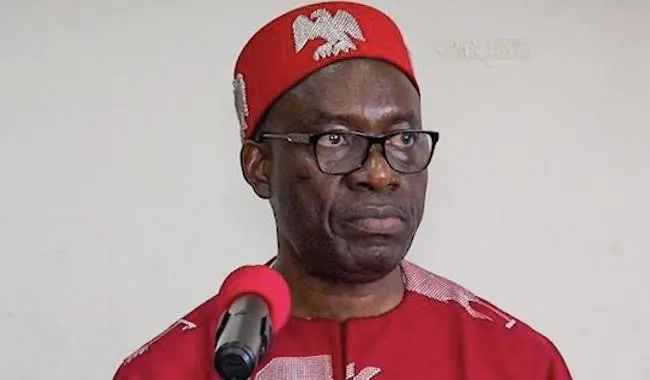
Soludo made the call on Thursday, November 12, 2026, while delivering the keynote address at the presentation of a book titled Economic Diversification and Structural Transformation in Nigeria: Past, Present, Future, authored by Abdulmumin Jibrin, at the State House Conference Centre, Presidential Villa, Abuja.
President Bola Ahmed Tinubu, who wrote the foreword to the book, attended as the special guest of honour. Chairman of BUA Group, Abdulsamad Rabiu, presented the publication, while Dr Reuben Abati reviewed it.
The Anambra governor, who is also a former Governor of the Central Bank of Nigeria, appeared at the event in traditional Akwete fabric, using his personal commitment to locally produced clothing to demonstrate the importance of supporting indigenous industries.
According to him, Nigerians can accelerate economic transformation by making deliberate choices to purchase and consume locally produced goods rather than depending excessively on imported alternatives.
Soludo argued that the collective purchasing power of Nigeria's population could create enormous opportunities for local manufacturers, attract foreign direct investment and generate millions of employment opportunities.
He challenged Nigerians to imagine the economic impact of a situation where citizens consistently chose Nigerian-made clothing, food and other products.
The governor explained that supporting domestic industries would encourage businesses to expand production, create employment and attract investors interested in meeting the demands of the Nigerian market.
Sharing his experience with Akwete fabric, Soludo disclosed that his daughter introduced him to the traditional textile in 2020 and that he subsequently adopted it as his regular outfit.
He also acknowledged the First Lady, Senator Oluremi Tinubu, for her commitment to promoting the fabric. The First Lady had previously pledged to wear Akwete attire if President Tinubu secured re-election in the 2027 general elections.
Soludo further explained that the eagle symbol featured on his traditional attire represented Nigeria's national identity, describing his choice of clothing as a daily expression of patriotism.
He said his administration had also incorporated the Made-in-Nigeria philosophy into its hospitality practices at the Governor's Lodge in Awka.
According to him, locally produced food and drinks are prioritised when receiving visitors, with imported alternatives reserved for exceptional circumstances.
Soludo maintained that supporting Nigerian products should become a national habit rather than an occasional campaign, urging public institutions and government officials to lead by example.
He specifically proposed that Nigerian-made fabrics should be adopted for official government functions before gradually becoming a regular choice for everyday dressing.
He believes such a policy would stimulate demand for locally manufactured textiles, encourage investment in the fashion industry and attract international companies interested in establishing production facilities in Nigeria.
The governor also urged citizens to take greater responsibility for the country's economic progress instead of constantly blaming external factors for its challenges.
He stressed that everyday decisions, including the products people purchase and the businesses they support, could contribute significantly to reducing poverty, creating employment and strengthening economic diversification.
Soludo maintained that national development goes beyond government policies, economic strategies and institutional reforms, arguing that citizens must first develop confidence in their country's productive capacity.
He called for a stronger national consciousness built around self-belief, collective responsibility and pride in Nigerian-made products.
The governor concluded his message by reaffirming his commitment to economic patriotism, urging Nigerians to take pride in their identity and actively support businesses and industries operating within the country.
Reporting by TalkNaijaMedia



Reader Comments (0)
No comments yet. Be the first to share your perspective on this report.