
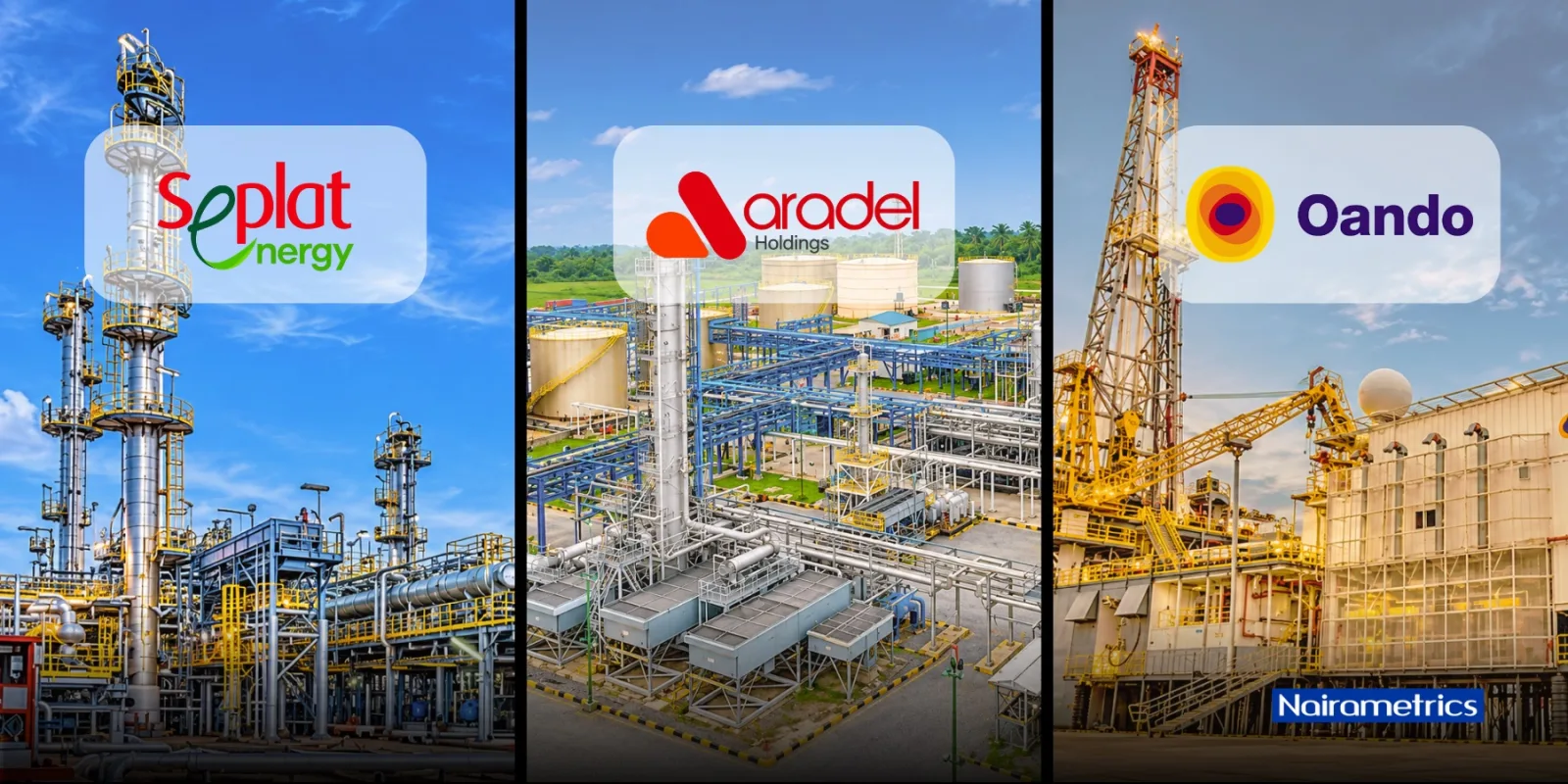
Despite the relatively close production figures between Seplat and Aradel, their cash generation differed considerably, highlighting how sales volumes, payment timing, investment spending and financing obligations can influence the amount of money available to an oil and gas company.
Aradel recorded the highest net cash generated from operating activities at approximately ₦2.46 trillion. Seplat reported about ₦1.26 trillion in net operating cash inflows in its naira-denominated financial statements, while Oando generated approximately ₦218 billion.
However, comparing operating cash flow alone does not provide the full picture. Companies must also meet capital expenditure, interest payments, debt obligations, acquisition costs and dividend commitments.
Aradel leads cash generation but working-capital movements matter
Aradel's strong cash performance followed the expansion of its business through the consolidation of ND Western and Renaissance operations.
The company generated approximately ₦2.46 trillion in net cash from operating activities during the nine-month period, compared with about ₦205.4 billion in the corresponding period of 2025.
After capital expenditure of approximately ₦570.6 billion and interest payments of about ₦216.5 billion, roughly ₦1.67 trillion remained on the simplified basis used for this comparison.
Nevertheless, the figure should not be mistaken for cash freely available for dividends. Aradel also made substantial payments towards its acquisition-related obligations, including approximately ₦543.9 billion in Renaissance earnout payments and about ₦363.9 billion in loan repayments.
The company's financial statements also show that an increase in trade and other payables contributed approximately ₦1.38 trillion to cash generated from operating activities before tax.
This means that working-capital movements played a major role in the reported cash performance. Some obligations had increased by the end of the reporting period, making it important for investors to assess whether the cash generation can be sustained as outstanding bills are settled.
Aradel ended September with cash and cash equivalents of approximately ₦2 trillion and moved from a net debt position of ₦475.1 billion at the end of 2025 to a net cash position of ₦532.3 billion.
The company also declared an interim dividend of ₦7 per share, amounting to approximately ₦30.4 billion.
Seplat combines strong production with debt reduction
Seplat's performance was supported by higher production, stronger realised oil prices and improved cash generation.
The company averaged 144,999 boepd in the first nine months, representing a seven per cent increase from 135,636 boepd recorded during the same period of 2025.
Its net cash inflows from operating activities stood at approximately ₦1.26 trillion, while reported free cash flow reached $749 million after capital expenditure.
Seplat also continued reducing its debt. Net debt fell to $234.9 million at the end of September, representing a 65 per cent reduction from $673.3 million at the end of 2025.
The company subsequently repaid the remaining $100 million balance on its Advanced Payment Facility on October 27, completing repayment of the debt raised to finance its 2024 acquisition of Mobil Producing Nigeria Unlimited.
Shareholder distributions also increased. Seplat paid approximately ₦240.3 billion in dividends during the first nine months of 2026, compared with about ₦146.9 billion in the corresponding period of 2025.
Its third-quarter dividend declaration totalled 19 US cents per share, comprising five cents in core dividend and 14 cents in special dividend.
The company also disclosed plans for a proposed transaction dividend of approximately 23.3 US cents per share following the expected completion of the sale of a 10 per cent interest in the NNPCL-Seplat joint venture to NNPC Limited.
The proposed payment remains conditional on the transaction being completed.
Oando records a significant cash flow recovery
Oando's performance was different from those of its larger production rivals, but its results showed a notable improvement in operational efficiency and cash generation.
The company averaged 42,985 boepd, representing a 14 per cent increase from 37,614 boepd in the corresponding period of 2025.
Its production operating cost also declined by 22 per cent to $15.39 per barrel of oil equivalent, compared with $19.67 a year earlier.
Facility uptime improved to 96.1 per cent from 85 per cent, reflecting better reliability across its operations.
More importantly, Oando moved from using cash in its operating activities in the corresponding period of 2025 to generating positive operating cash flow in 2026.
Its net cash inflow from operating activities reached approximately ₦217.8 billion after tax and other operating cash payments. Following capital expenditure of about ₦110.7 billion, approximately ₦107.1 billion remained.
The company also reduced its total borrowings to approximately ₦2.16 trillion, although its financing obligations remain considerably higher than those of its competitors.
Oando's operating recovery has not yet translated into stronger overall earnings. It reported profit after tax of ₦106.5 billion, down from ₦201.3 billion a year earlier, partly because of substantial finance costs associated with acquisition debt.
For investors, the next important test will be whether the company can sustain higher production, maintain lower operating costs and continue generating positive cash after funding its investment programme.
Share market performance tells a different story
The companies' stock market performance did not follow the same order as their cash generation.
At the close of trading on Friday, November 6, 2026, Seplat had gained approximately 175.4 per cent year-to-date, making it the strongest performer among the three.
Aradel followed with a gain of about 93.4 per cent, while Oando remained down approximately 17.7 per cent despite recording a positive cash flow turnaround.
Oando's shares closed at ₦33.10 on November 6, rising 5.08 per cent from the previous closing price of ₦31.50.
The figures demonstrate that strong cash generation does not automatically translate into the biggest share price increase. Investors also consider debt levels, earnings quality, future production prospects, dividend policies, acquisition risks and the price they are paying for a company's shares.
What investors should watch going into 2027
Aradel enters the next financial year with a larger production base and a stronger reported net cash position. However, investors will need to monitor how its cash generation performs after acquisition-related payments, capital expenditure and other outstanding obligations.
Seplat has strengthened its balance sheet through debt repayment and increased shareholder distributions. Its ability to maintain production, generate free cash flow and sustain dividends will remain important, particularly if international oil prices weaken.
For Oando, the priority is to demonstrate that its improved production and lower operating costs can consistently translate into cash surpluses. Sustained operational reliability and reduced financing costs could strengthen its financial position over time.
Ultimately, the comparison shows that production leadership, cash generation and stock market performance are three different measures of corporate strength. While Seplat leads in production and share price gains, Aradel has generated the most operating cash, and Oando has recorded a notable financial recovery.
The next reporting periods will reveal whether these companies can sustain their performance while meeting investment commitments and delivering lasting value to shareholders.
Reporting by TalkNaijaMedia



Reader Comments (0)
No comments yet. Be the first to share your perspective on this report.