

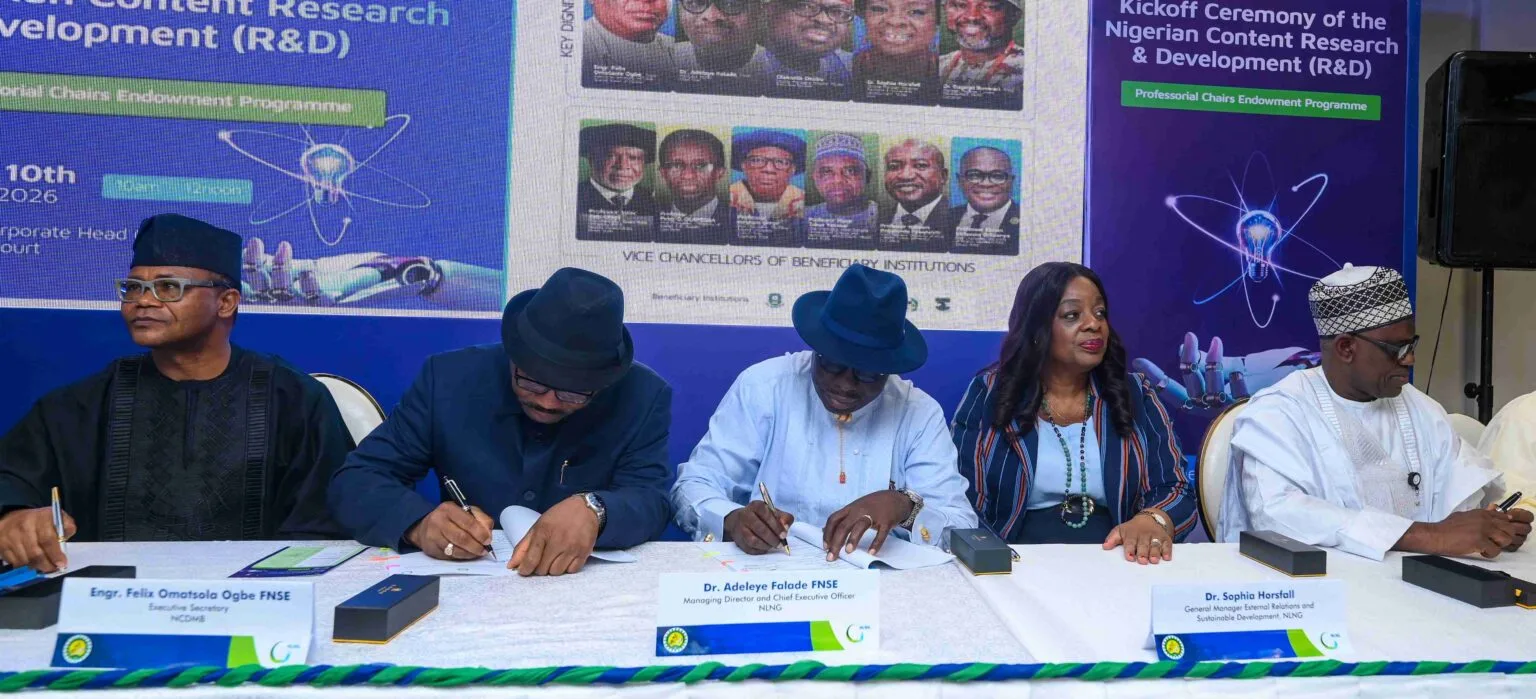
NLNG Managing Director and Chief Executive Officer, Adeleye Falade, announced the initiative at its launch in Port Harcourt on Tuesday. The programme is being implemented in partnership with the NCDMB through its Directorate of Planning, Research and Statistics.
The beneficiary institutions are the University of Ibadan, Rivers State University, Modibbo Adama University in Yola, Aliko Dangote University of Science and Technology in Kano, the University of Nigeria, Nsukka, and Yakubu Gowon University, formerly known as the University of Abuja.
The universities will focus on different areas of research relevant to Nigeria’s energy sector. The NLNG Research and Innovation Centre for Computer and Electrical Engineering at Rivers State University is expected to serve as the coordinating centre for collaboration among the institutions.
The University of Ibadan will concentrate on natural gas processing, pollution control and environmental management, while Rivers State University will focus on digital engineering, intelligent energy systems, automation and asset integrity.
Modibbo Adama University will undertake research on energy transition and the environment. Aliko Dangote University of Science and Technology will work on sustainable energy innovation and climate-resilient food systems.
At the University of Nigeria, Nsukka, the research focus will include green energy production and geoenvironmental engineering. Yakubu Gowon University will concentrate on geoscience and satellite intelligence for resilient gas infrastructure.
Falade said the programme was designed to strengthen the relationship between government, industry and academic institutions, ensuring that research findings can be developed into practical solutions for industrial challenges.
He identified key areas of interest to include operational efficiency, emissions management, industrial safety, the maintenance of critical infrastructure and more sustainable industrial processes.
The NLNG chief executive also highlighted plans to encourage academic exchanges, specialised training programmes, sabbaticals, practical research and joint postgraduate curriculum development.
He disclosed that discussions were ongoing with Rivers State University on the implementation arrangements and commended its Vice-Chancellor, Professor Isaac Zeb-Obipi, for supporting the collaboration.
Falade further revealed that potential partners, including Google, Cisco and MTN, had expressed interest in supporting the initiative. Their participation, however, remains at the level of interest disclosed by the NLNG management.
He urged the beneficiary universities to use the endowment as a foundation for attracting additional research funding, strengthening partnerships and developing intellectual property with commercial potential.
Also speaking at the launch, NCDMB Executive Secretary, Felix Omatsola Ogbe, described the programme as a strategic investment in Nigeria’s research and innovation ecosystem.
Ogbe said the initiative would help address the longstanding gap between academic research and industrial application by connecting university expertise with the practical needs of the oil and gas industry.
He challenged the institutions to move beyond research primarily intended for academic publications and give greater attention to findings that can be applied to real industry problems.
According to him, the universities would be expected to establish clear research objectives, deliver measurable outcomes, manage the funds responsibly and maintain effective collaboration with industry partners.
The programme is expected to provide opportunities for postgraduate students and younger researchers to gain practical exposure through engagement with experienced academics and industry professionals.
The endowment also includes provisions for minor construction works and infrastructure improvements to prepare suitable spaces for the research centres.
Through the initiative, NLNG and NCDMB are seeking to strengthen Nigeria’s ability to develop home-grown technologies, improve industrial competitiveness and build a stronger pool of local research and technical expertise.
Reporting by TalkNaijaMedia





Reader Comments (0)
No comments yet. Be the first to share your perspective on this report.