

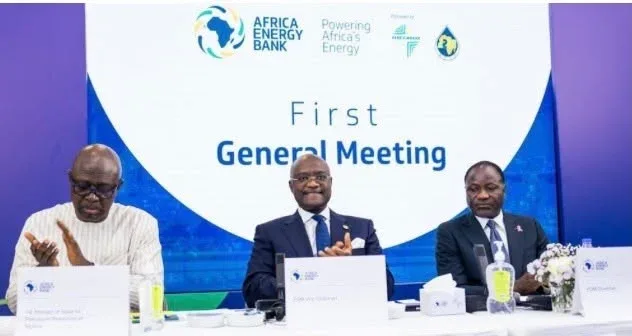
In a joint announcement, the two institutions said the new bank would have an authorised capital of $5 billion and support investments across Africa's energy value chain, including oil and gas exploration, production, transportation, processing, refining and distribution.
The establishment comes at a time when Africa's energy investment requirements are estimated at approximately $200 billion, while traditional international lenders are increasingly reducing their exposure to fossil fuel projects.
According to the promoters, the Africa Energy Bank is expected to help address the continent's financing challenges while supporting an energy transition that recognises the development needs and economic realities of African countries.
Its mandate includes strengthening local energy production, expanding refining and processing capacity, reducing dependence on imported petroleum products and encouraging trade in energy resources among African countries.
The institutions also emphasised the importance of increasing African participation in the continent's energy industry, ensuring that local governments, businesses and investors play a greater role in shaping the sector's future.
At the inaugural general meeting, Helmy Ghazi was appointed as the bank's first president, while members also approved the constitution of its inaugural Board of Directors.
The board is expected to comprise representatives from the public and private sectors, alongside policy institutions from different parts of the continent.
The meeting attracted prominent energy and financial sector officials, including Nigeria's Minister of State for Petroleum Resources (Oil), Heineken Lokpobiri; Afreximbank President and Chairman of its Board, George Elombi; and Côte d'Ivoire's Minister of Mines, Petroleum and Energy, Mamadou Sangafowa-Coulibaly.
Beyond oil and gas projects, the bank is also expected to support investments in electricity generation and transmission infrastructure, which are considered essential to Africa's industrial development and growing energy requirements.
Afreximbank and APPO specifically highlighted the increasing electricity demands associated with emerging technologies, particularly artificial intelligence, as another reason for strengthening the continent's energy financing capacity.
The promoters said the institution would operate as an independent, supranational pan-African financial organisation, seeking investments from governments, national oil companies, financial institutions and private investors.
However, the bank's $5 billion authorised capital should not be confused with funds already disbursed or immediately available for lending. The amount represents its approved capital structure, while its ability to finance projects will depend on capital mobilisation and operational arrangements.
The establishment of the institution marks a major step in efforts by African petroleum-producing countries to develop homegrown financing solutions for energy infrastructure and reduce dependence on external funding sources.
Meanwhile, Afreximbank disclosed that its total assets and contingencies exceeded $54.1 billion as of September 2026, while its shareholder funds stood at $9 billion.
APPO, which was established in Lagos in January 1987, is an intergovernmental organisation that promotes cooperation among African oil-producing countries through policy coordination, technical collaboration and the exchange of industry knowledge.
With the formal establishment of the Africa Energy Bank, both institutions are expected to draw on their experience and networks to attract investment and support the development of Africa's energy sector.
Reporting by TalkNaijaMedia



Reader Comments (0)
No comments yet. Be the first to share your perspective on this report.