

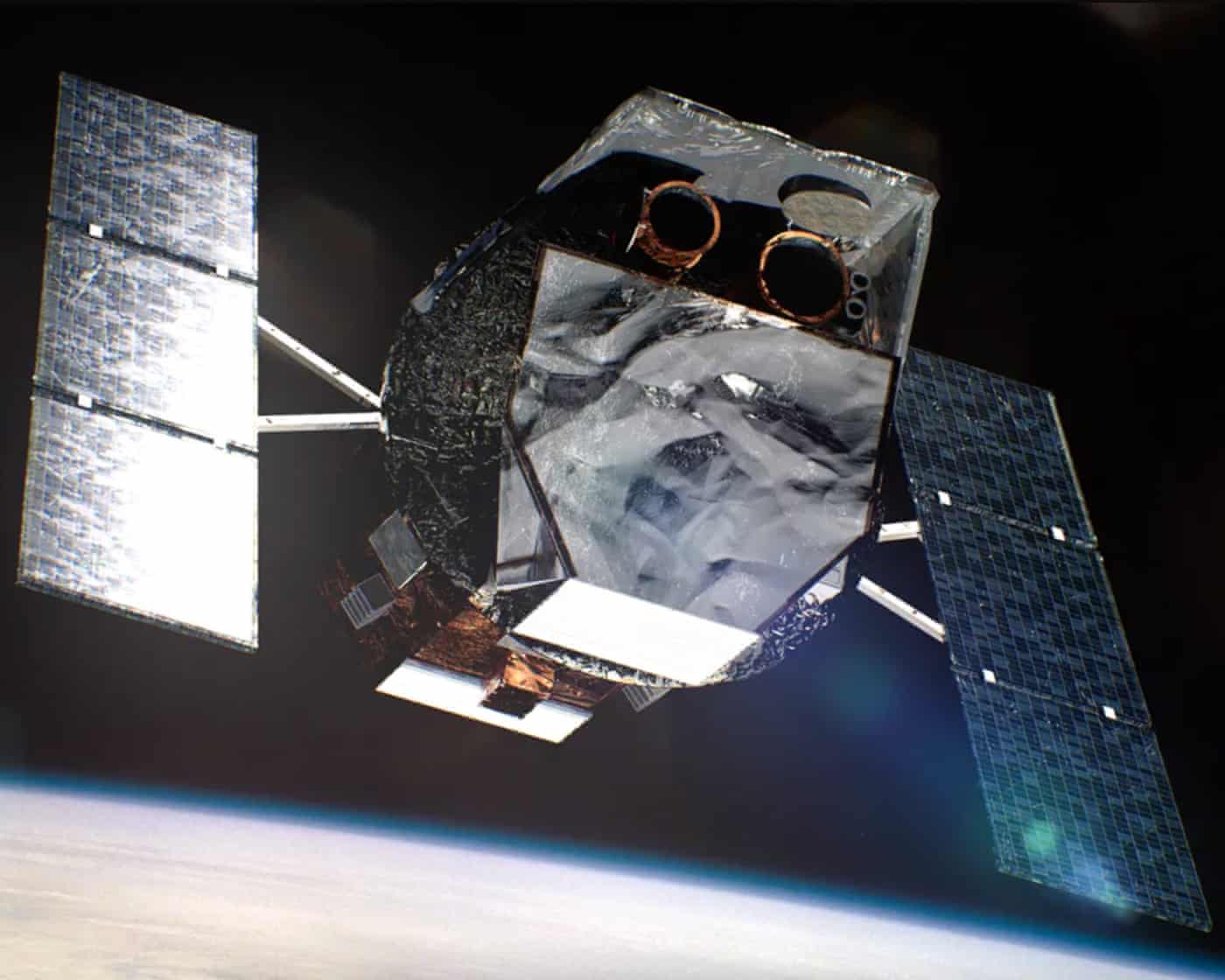
NASA had contracted Arizona-based Katalyst Space Technologies in September 2025 to develop a robotic spacecraft known as LINK, which was intended to approach, capture and raise Swift’s orbital altitude.
LINK was launched on July 3, 2026, aboard a Northrop Grumman Pegasus XL rocket. However, the rescue effort encountered serious technical problems involving the spacecraft’s attitude-control system, affecting its ability to maintain the required orientation and safely approach Swift.
In August, NASA and Katalyst confirmed that LINK would no longer attempt to capture or boost the observatory. The spacecraft subsequently completed its own mission and re-entered Earth’s atmosphere on September 25, 2026.
Swift’s eventual descent was accelerated by increased solar activity, which heated and expanded Earth’s upper atmosphere, creating greater atmospheric drag on the observatory and gradually lowering its orbit.
NASA had warned before the re-entry that most of the spacecraft was expected to burn up as it passed through the atmosphere, although some heavier components could survive and reach the ground.
The agency had estimated the risk of anyone on Earth being harmed by surviving debris at approximately one in 2,100. No immediate reports of injuries or property damage were confirmed following the re-entry.
Launched on November 20, 2004, the Swift Observatory was originally designed for a two-year mission to study gamma-ray bursts, which are among the most powerful explosions in the universe.
The spacecraft continued operating far beyond its expected lifespan, using three specialised telescopes to observe cosmic events across different wavelengths, including gamma-ray bursts, supernovae, black holes and other astronomical phenomena.
During its operational lifetime, Swift detected more than 2,000 gamma-ray bursts and contributed to thousands of scientific studies. Its rapid observations also helped scientists coordinate follow-up investigations of short-lived cosmic events using other telescopes around the world.
Although the rescue mission failed to extend its lifespan, NASA described the effort as an important demonstration of the possibilities of commercial robotic spacecraft servicing.
The agency said the experience would provide useful knowledge for future missions aimed at repairing, servicing or extending the operational lives of satellites already in orbit.
Swift’s return to Earth therefore marks the end of a major chapter in space-based astronomy, but its scientific observations are expected to remain valuable to researchers for years to come.
Reporting by TalkNaijaMedia





Reader Comments (0)
No comments yet. Be the first to share your perspective on this report.