

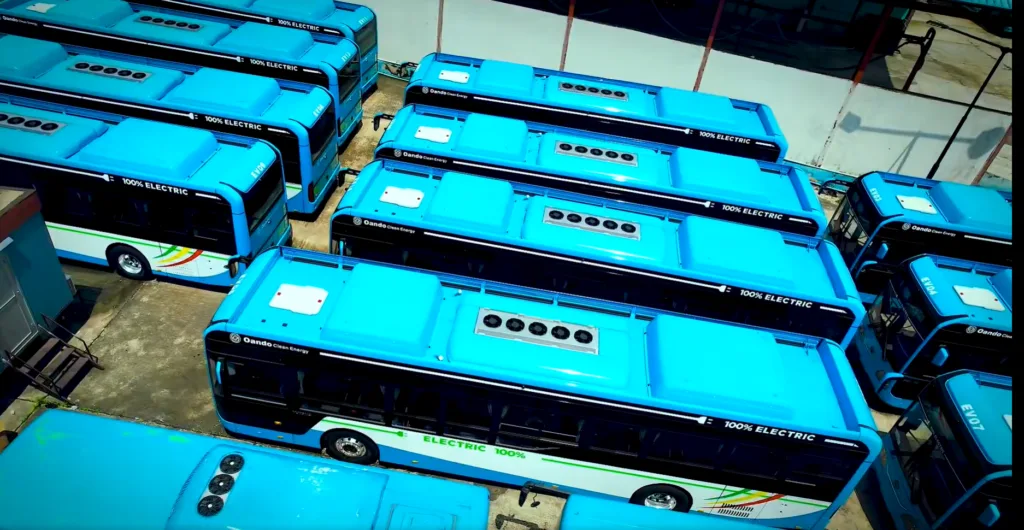
Hadiza Adukonu, Vice President of Opportunity, Maturation and New Ventures at Oando Clean Energy, announced the latest delivery in a video shared by LAMATA on its official X account.
She explained that the 11 vehicles represent the first batch of an additional 50 electric buses planned for Lagos, with 39 more expected to arrive as the project progresses.
The initiative is part of a broader ambition to introduce an initial 50 zero-emission buses into the state's public transport network, with a long-term target of expanding the electric fleet to 552 vehicles.
Oando Clean Energy and LAMATA established their partnership in 2022 through a Memorandum of Understanding aimed at developing electric mass transportation and supporting infrastructure across Lagos.
The first phase began in May 2023 with the introduction of two electric buses for public transport operations. The initial deployment served as a proof-of-concept exercise to assess the suitability of electric vehicles for Lagos' busy transport environment.
The latest delivery marks a significant expansion of that initial operation.
According to information provided by Adukonu, the first two buses have transported approximately 788,000 passengers and covered about 433,000 kilometres since their introduction. The figures were presented as evidence of the project's operational performance.
Oando's more recent nine-month 2026 business update also reported that the electric buses operating under the LAMATA partnership recorded more than 212,000 passenger journeys during the first nine months of the year, with average capacity utilisation of 73 per cent.
The company said the newly delivered buses were expected to enter service during the fourth quarter of 2026, with LAMATA responsible for operating them on behalf of the Lagos State Government.
Push for cleaner public transportation
The electric bus expansion forms part of Lagos State's wider effort to modernise its public transportation system while reducing the environmental impact of road transport.
Electric vehicles do not produce exhaust emissions while operating, offering an opportunity to reduce roadside air pollution and noise along busy transport corridors. Their wider adoption could also reduce the transport sector's dependence on diesel and other conventional fuels.
LAMATA's transition strategy includes encouraging the adoption of cleaner alternatives, particularly compressed natural gas (CNG) and electric vehicles, as operators introduce new buses into the regulated public transport system.
The state has also received support from other clean-mobility initiatives. In September 2026, the Presidential Initiative on Compressed Natural Gas and Electric Vehicles announced the deployment of 35 additional buses for LAMATA operators, comprising 15 CNG buses and 20 electric buses.
The different interventions reflect growing efforts to increase public transport capacity and introduce alternative energy options into Lagos' transport network.
However, expanding electric mobility will require more than the delivery of vehicles. Reliable charging facilities, maintenance arrangements, trained personnel and effective route planning will be important to sustaining the service.
Oando's original agreement with LAMATA included plans for an electric vehicle infrastructure ecosystem involving buses, charging stations and supporting facilities.
With 11 additional buses now delivered, attention will turn to their deployment and the arrival of the remaining vehicles under the planned initial expansion.
If the longer-term 552-bus ambition is achieved, the project could become an important part of Lagos' transition towards a more modern and environmentally sustainable public transport system.
Reporting by TalkNaijaMedia



Reader Comments (0)
No comments yet. Be the first to share your perspective on this report.